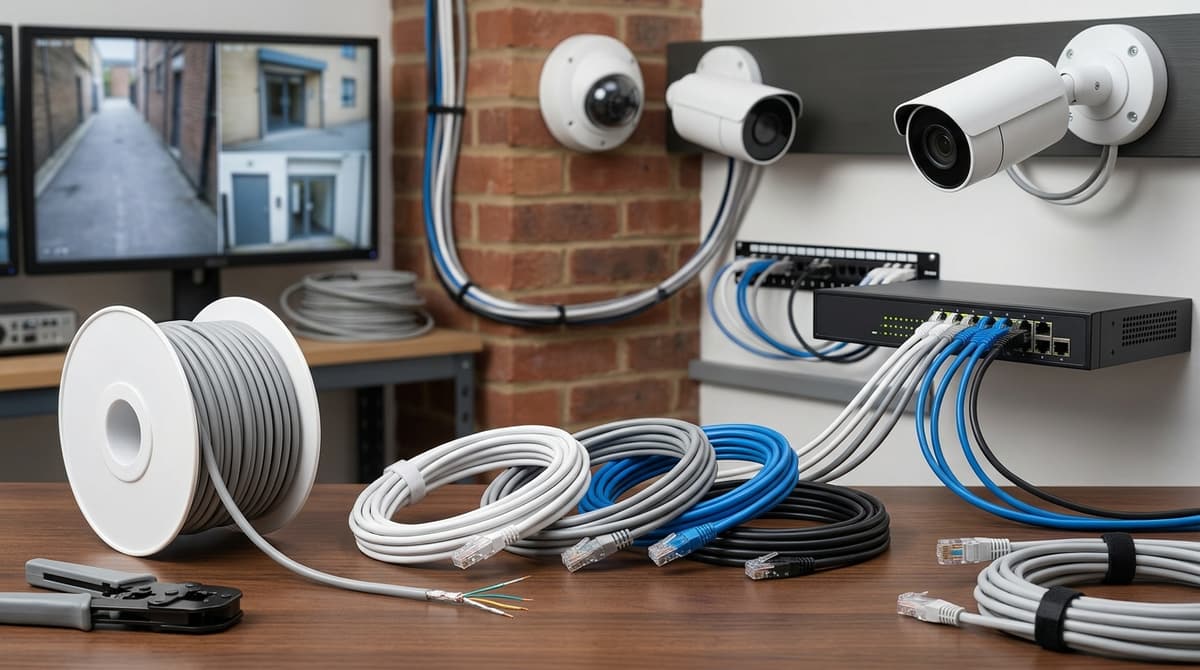
For CCTV runs, Cat5e is the practical minimum, Cat6 is the sensible default, and Cat6a earns its cost only on long PoE+ runs or near EMI sources; always spec solid-core, outdoor-rated cable for anything leaving the building. Get the category and core type wrong on a UK install and you'll be re-pulling cable after the first winter, not just losing a few frames per second.
Which Ethernet Cable Category Do You Actually Need for CCTV?
For most single-camera PoE installs, Cat5e is enough; once a job involves 4K cameras, PoE+, or several long runs together, Cat6 is the safer default. The right category depends on run length, camera resolution and power draw rather than a single blanket answer.
Cat5e — fine for standard resolution, shorter runs
Cat5e supports Gigabit Ethernet up to 100m and handles typical 2–4MP PoE cameras on shorter cable runs without issue. It's the cheapest option and still widely stocked as external, solid-copper reels in our Ethernet range, including a 100m outdoor Cat5e UTP cable with 100% solid copper conductors.
Cat6 — the sensible default for new jobs
Cat6 keeps the same 100m limit for Gigabit Ethernet but its tighter twist rates and higher-spec conductors give more headroom against crosstalk when several cable runs share one containment. This is the category most installers now default to for new CCTV jobs, and it's what we stock in the widest range of lengths — from a 1m patch lead up to a 40m Cat6 RJ45 lead for longer camera-to-switch runs (account pricing applies).
Cat6a — worth specifying for PoE+ near the 100m limit
Cat6a earns its place where a run approaches the 90–100m ceiling while carrying PoE+ (25.5W per port) to a high-draw PTZ camera or a heated housing. The extra shielding and construction reduce the risk of voltage drop and interference degrading power delivery over that distance.
| Category |
Gigabit limit |
Best suited to |
| Cat5e |
100m |
Single 2–4MP PoE cameras, shorter runs |
| Cat6 |
100m |
Mixed 4K/PoE+ projects, multiple runs in one containment |
| Cat6a |
100m (PoE+ headroom) |
PTZ/heated housings on long runs |
The takeaway: spec Cat5e only for simple, short jobs — for anything mixing 4K, PoE+ or multiple runs, Cat6 is the category to standardise on.
Cat5e vs Cat6 for CCTV: Does the Category Actually Matter Here?
Yes, but rarely for the reason installers assume — cable category matters for headroom, PoE heat and how many cores you're cramming into one route, not raw megapixel bandwidth.
A single 4-8MP IP camera on PoE almost never touches the bandwidth ceiling of Cat5e, so on a lone run the category limit isn't your bottleneck. Where it starts to matter is thermal: several PoE+ cables bundled tightly in one tray or conduit generate heat under sustained power draw, and Cat6's thicker 23-24 AWG copper and tighter twist geometry handle that better than Cat5e's typical 24 AWG.
| Factor |
Cat5e |
Cat6 |
Cat6a |
| Max length (Gigabit) |
100m |
100m |
100m |
| Typical AWG |
24 |
23-24 |
23 |
| Crosstalk headroom |
Lower |
Better |
Best |
| PoE+ heat handling |
Adequate short runs |
Good |
Best for bundled runs |
| Cost |
Lowest |
Mid |
Highest |
For most single-camera CCTV runs, Cat5e is technically sufficient — Cat6 earns its keep on multi-camera bundles, longer runs and any install where you want margin against future higher-power PoE devices.
What this means for spec'ing a job
- Single camera, short conduit run: Cat5e is fine, but stock is often mixed with data cabling anyway.
- 8+ cameras bundled in one containment run: Cat6 reduces crosstalk and heat build-up under load.
- Mixed-use site (CCTV plus general LAN, PoE access points): standardising on one category simplifies stock and testing — a Cat6 Ethernet Cable 40m RJ45 Patch Lead Black covers both without a second SKU to manage (account pricing applies).
If you're already ordering ethernet cables for PoE devices, LAN switches or a mixed camera-and-data install, holding one Cat6 stock line rather than splitting between Cat5e and Cat6 saves admin more than it saves pence per metre. For short patch runs between switch and NVR, a 1m or 3m Cat6 lead does the job without excess slack in the cabinet — or for longer runs to a distant NVR, a 10m extension lead keeps cable management clean without excess coils.
Solid vs Stranded Core: Which Is Right for a Fixed CCTV Run?
Solid core is correct for any permanent camera-to-NVR run; stranded core belongs in short patch leads that get moved, flexed or re-terminated. The two conductor types aren't interchangeable, and choosing wrongly shows up later as flaky links or connectors that fail after a few months of vibration.
Solid core offers lower resistance over distance, which matters on a long pull from a camera position back to a cabinet, and it terminates far more reliably onto punch-down keystones and patch panel backs. Structured cabling standards specify solid conductors for fixed horizontal runs precisely because a punched termination on stranded wire tends to work loose over time. This is the format to run from camera to NVR through a wall, loft void or duct — anything installed once and left alone.
Stranded core trades some of that termination reliability for flexibility, tolerating repeated bending without the conductor fatiguing and snapping. That makes it the right choice for a lead that gets unplugged, coiled, or moved around a desk or rack — but it doesn't punch down as cleanly onto a keystone or patch panel, and it isn't intended for long fixed installation runs.
In practice, most CCTV installs need both: solid-core bulk cable for the wall run, and a short stranded patch lead at each end onto the NVR or switch. For that final jump a ready-made lead is the sensible option — something like a Cat6 1m Ethernet Cable – High-Speed RJ45 Patch Lead or a 3m White Cat6 RJ45 Ethernet Cable – 250MHz, both rated to 250MHz with gold-plated RJ45 connectors, saves re-terminating a stranded lead by hand.
What Ethernet Cable Do You Need for an Outdoor or Direct-Burial CCTV Run?
Any cable leaving the building envelope needs a jacket rated for outdoor exposure — indoor-only PVC-jacketed cable will crack and let in moisture within a season of UV and damp. Choosing the right outdoor cable is one of the most common questions we field alongside general ethernet cables for security cameras runs, and it's worth getting right before you climb a ladder rather than after a camera drops offline.
External-rated (PE/UV-stable jacket)
For runs in conduit, clipped along a wall, or tucked under eaves, you need a polyethylene jacket rated for UV and weather. Our Ethernet category stocks external Cat5e in a 100% solid-copper build specifically for this — it's the difference between a run that lasts years and one that's brittle by next winter. For most installations, the best Cat6 ethernet cable for outdoor CCTV use combines that same solid-copper construction with Cat6's superior thermal handling under bundled PoE loads.
Direct burial vs conduit
Only cable with a gel-filled or fully water-blocked core is suitable for going straight into the ground with no conduit. The safer, cheaper route for most installers is standard external cable pulled through ducted conduit — you avoid the cost of true direct-burial stock and get a serviceable path if a run ever needs replacing.
Solid copper vs CCA
For outdoor and PoE-powered camera runs, solid bare-copper conductors carry current and signal more reliably over distance than copper-clad aluminium (CCA), which matters when a PoE camera or PTZ head is drawing power over the same pair as the data. This is where CCA cut corners indoors often show up outdoors — resistance losses bite harder once you add UV cycling and temperature swings to a long, powered run.
Related products from our own range: