
Cameras
Single Use Cameras vs CCTV: Why They Fail in 2026
Single use cameras are made for party snapshots, not deterrence or evidence — they have no live feed, no timestamp metadata, no remote access, and the film…
On this page
- Single Use Cameras vs CCTV: Why Disposable Film Cameras Fail as Security in 2026
- Where the gap actually bites
- What actually satisfies UK evidential standards
- Why do people even consider single use cameras for security?
- Can a single-use camera actually deter or catch anyone in the act?
- Would the photos even hold up as evidence?
- How do single-use cameras perform after dark, when most incidents happen?
- Why the flash doesn't solve it
- No exposure control, no sensor rating
Single use cameras are made for party snapshots, not deterrence or evidence — they have no live feed, no timestamp metadata, no remote access, and the film sits undeveloped for days. If you're weighing one up as a "cheap CCTV alternative", the honest answer is: it isn't one, and here's exactly why, along with what a proper installation — cabled with RG59 coax and run off a stable 12V supply — actually delivers instead.
Single Use Cameras vs CCTV: Why Disposable Film Cameras Fail as Security in 2026
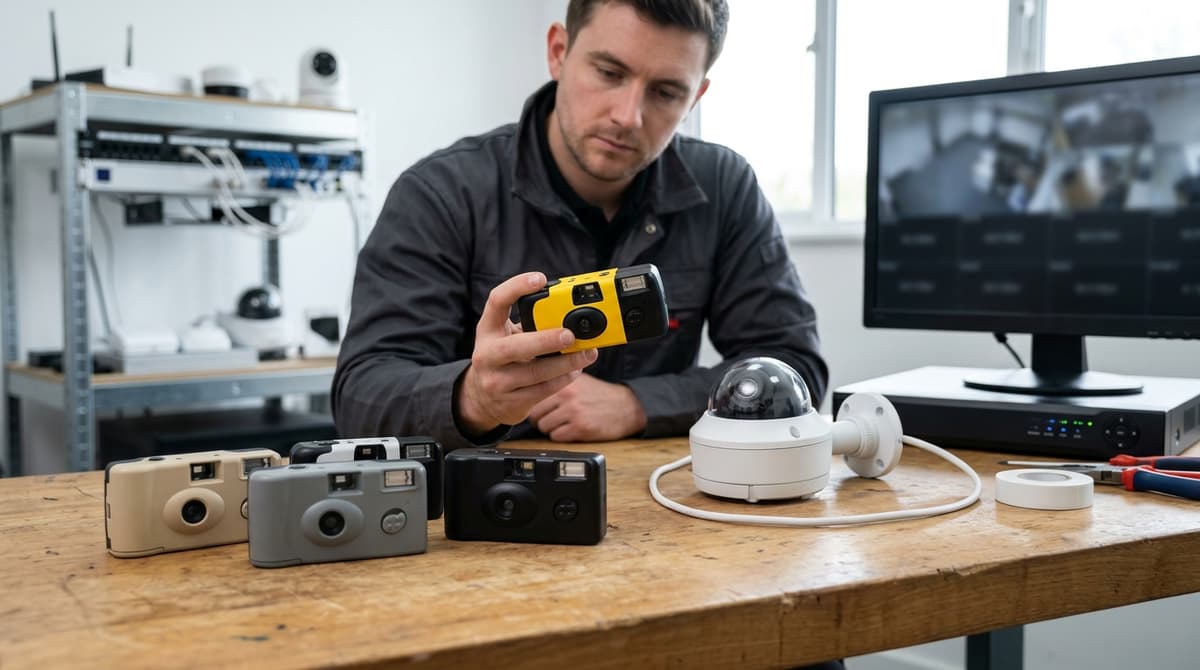
Single use cameras cannot function as security equipment because they capture nothing until someone points and clicks, then sit undeveloped for days with no timestamp, no live feed and no way to review an incident in progress. A Kodak or Novocolor disposable — entry-level priced units sold for weddings and festivals — has no motion detection, no recording buffer, no night vision beyond an on-camera flash, and no remote viewing. Compare that with even an entry-level IP camera: continuous recording to an NVR, IR illumination for low-light coverage, and footage retrievable the moment an incident is flagged, not after a chemist has processed the roll.
Where the gap actually bites
- No timestamp or metadata — evidential CCTV footage needs a reliable time/date overlay; a disposable's 27 or 39 exposures carry none.
- No live monitoring — a break-in happens once; a disposable camera left on a shelf records nothing unless a person is physically holding it at that second.
- Processing delay — developing single use cameras in the UK typically means dropping film at a chemist or postal lab and waiting days, by which point any incident is long over.
- No retention control — the ICO's CCTV code expects operators to manage a defined retention period and access controls; a single roll of film sat in a drawer meets neither.
- No deterrent value — visible, purpose-built cameras with signage are what actually discourage opportunist crime; a disposable camera is neither visible in use nor recognisable as surveillance.
What actually satisfies UK evidential standards
A genuine CCTV installation needs continuous recording, correct time-stamping, and footage that can be exported without degradation — none of which a disposable film camera can provide at any price point. Analogue systems still rely on solid transmission runs, which is why installers commonly spec 100-metre reels such as the RG59 coaxial cable (mid-range priced) for camera-to-DVR links, paired with a stable 12V supply — a job an 8A distribution PSU is designed for when running several analogue cameras off one box, sized correctly against the total camera draw.
For anyone still shopping single use cameras — cheap single use cameras for a wedding favour table, bulk packs for a festival, or the best single use cameras for holiday snaps — that's a legitimate, separate purchase with no crossover into security. For actual premises protection, trade buyers can open an account at CCTVLine or browse 6 camera kits and other IP and analogue stock, 3 camera kits, 12 camera kits, and more at cctvline.co.uk.
Why do people even consider single use cameras for security?
Because the phrase "single use cameras" is genuinely popular — around 49,500 searches a month in the UK — but almost none of that demand is about catching intruders. They're a leisure product being pulled into a surveillance job it was never designed for.
Look at what actually surrounds the term: cheap single use cameras, single use cameras for weddings, single use cameras bulk, single use cameras with free processing. That's confetti, guest tables and festival wristbands, not a shop counter or a fire exit at 2am. Kodak Alaris markets its disposable range explicitly as a grab-and-go option "when you don't want the hassle of taking extra camera gear" — a line aimed at holidaymakers and wedding guests, not loss-prevention managers.
Retail supply backs this up. Boots and specialist film retailers stock single-use cameras as novelty or event products, and the Wikipedia overview of disposable cameras describes them as designed to be handed back whole so the lab can process the film and recycle the body — a one-shot product built around a single roll of 35mm film, a fixed-focus lens and no image storage until it's developed days later.
That last point is the whole problem for security use:
- No live feed, no recording loop, nothing to review until the roll is developed
- Fixed exposure and lens, no low-light performance rated to any surveillance standard
- One roll, then the camera is finished — there's no continuous coverage
- Built for a wedding weekend, not a retention period measured in weeks
A camera designed to be posted off for developing single use cameras UK-wide, days after the moment's passed, was never going to log an incident in real time. For anywhere that actually needs coverage — a shop front, a yard, a fire exit — that gap is exactly what PoE cameras and NVR storage exist to close, which is the territory worth exploring next rather than pushing a leisure product further than it can go.
Can a single-use camera actually deter or catch anyone in the act?
No — a disposable camera can't deter or catch anyone in real time, because deterrence and intervention both depend on someone watching now, and film only reveals what happened after it's processed. There's no live feed, so nobody can intervene while an incident is actually happening.
This matters for anyone tempted to use single use cameras as a cheap alternative to proper CCTV, rather than for what they're genuinely good at — weddings, parties, holidays.
- No motion triggering. A disposable fires only when someone physically presses the shutter; it has no sensor to wake it when a person crosses your yard at 2am, unlike a CCTV camera with a PIR or video-analytics trigger.
- No remote viewing. Modern IP CCTV lets you check a phone app from anywhere in real time; a single-use camera's images stay invisible until the roll is out and developed, which could be days or weeks later.
- No live deterrent effect. A hidden disposable deters nobody because nobody sees it, and even a visible one doesn't broadcast "you're being recorded right now" the way an active camera with clear signage does — the ICO's CCTV guidance expects visible systems to signal ongoing monitoring, which a dormant film camera simply can't do.
- Fixed 27–39 shots. Once the roll's exposures are used, whatever happens next goes unrecorded entirely — there's no rolling buffer or overwrite-on-loop the way there is with hard-drive storage.
For genuine deterrence or evidence you can act on same-day, that job belongs to networked CCTV, not a disposable camera — browse cameras and recorders at CCTVLine or open a trade account at cctvline.co.uk/account.
Would the photos even hold up as evidence?
Rarely, and not without real problems — evidential CCTV footage needs a verifiable, continuous timestamp and an unbroken chain of custody, and film delivers neither. A processed print or scan from a disposable camera has no embedded timestamp or metadata tying it to the moment of an incident, so it's a poor substitute for a proper recorded system.
No timestamp or metadata integrity. An NVR overlays a frame-accurate time code onto every recorded stream and ties it to a device ID, which is exactly what a court or insurer wants to see when a claim depends on when something happened. A disposable camera's negatives carry none of that — no device serial, no continuous clock, nothing to prove a frame was exposed at the moment a reported incident took place, only the sequence in which shots were taken on the roll.
Delayed processing kills any evidential window. Film sits undeveloped until you drop it off and collect it, whether that's a same-day photo counter or a mail-order lab — by the time a print exists, the incident, and any chance to review footage while it still mattered, is long gone. A CCTV system's whole value is that footage can be pulled and reviewed within minutes; a disposable camera's cannot.
No redundancy, no backup. One exposed roll is one chance — drop it, overexpose it, or damage it during developing single use cameras uk labs handle every day, and there's no second copy sitting on a hard drive. For anything that actually needs proving after the fact, a recorded CCTV system with proper retention remains the only sound choice; browse NVRs and cameras built for that job at cctvline.co.uk.
How do single-use cameras perform after dark, when most incidents happen?
Badly — most single-use cameras have no meaningful low-light capability at all, and that's exactly when break-ins and vandalism tend to occur. A fixed small lens and fast-but-thin film are no substitute for a purpose-built low-light sensor, and treating a disposable camera as a security tool after dark is a mistake worth flagging early, before anyone relies on one for evidence.
Why the flash doesn't solve it
A CCTV camera built for night work uses infrared LEDs to record in 0 lux, well beyond the reach of any visible light. A single-use camera's built-in flash only illuminates a few metres, so anything beyond a doorway or a car bonnet stays black on the negative — and the flash itself announces the camera's position to whoever's in frame, which is the opposite of what a security installer wants. Compare the 5 camera kits available for night-time coverage.
No exposure control, no sensor rating
CCTV datasheets quote lux ratings and sensor size because both determine how much usable image survives in poor light; a disposable camera has a fixed aperture, fixed shutter speed and no sensor to tune at all. Even ISO 400 or 800 film, the fastest commonly sold in single-use bodies, still needs far more light than a typical night-time incident provides.
Some ranges make the limitation explicit rather than leaving buyers to find out the hard way. Daylight-only variants — common among single-use cameras for weddings sold with no flash fitted — are listed by UK film retailer Classic Photo Supplies as unsuited to indoor or low-light shooting at all, intended purely for bright outdoor use.
For anything after dark — car parks, side gates, stockrooms — a proper low-light-rated CCTV camera is the only realistic option, not a disposable body designed for daytime snapshots.