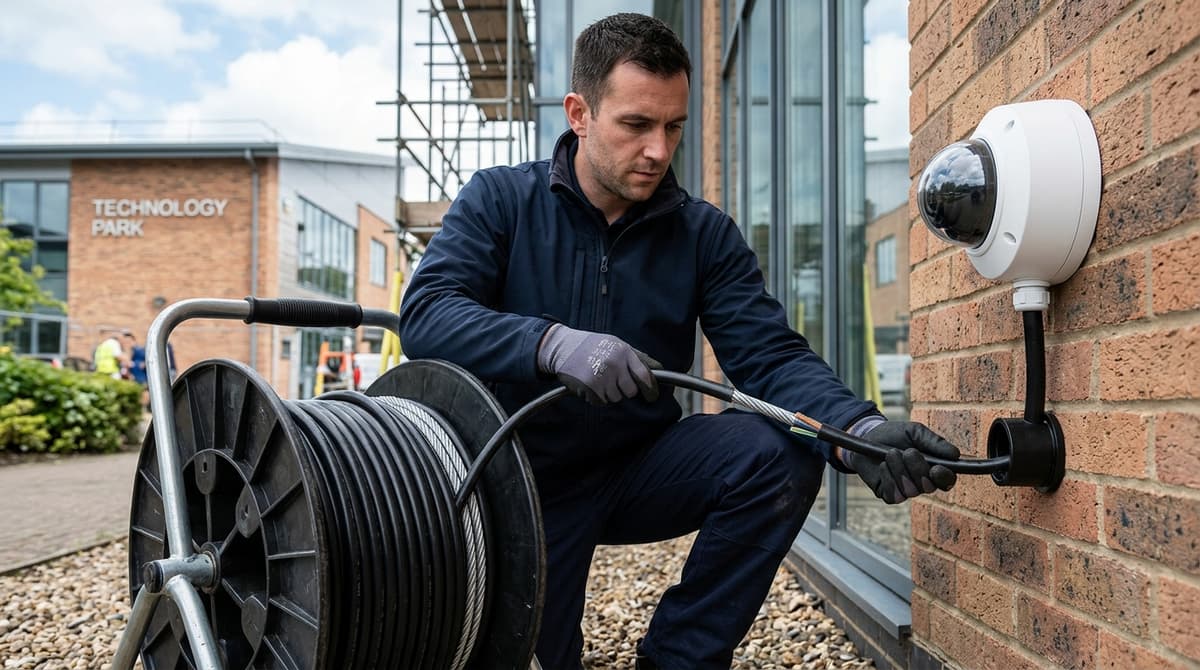
Where SWA Actually Belongs on a CCTV Job
Steel wire armoured cable earns its place when a run is buried, crosses a driveway, or carries mains power to an outdoor PTZ or pole-mounted enclosure. For a standard camera data run, external-grade Cat cable is simpler, cheaper, and far easier to terminate than SWA.
Get that split settled at the design stage, because it decides your cable list and your labour time. For most single-camera and small-PTZ power feeds, 3-core 1.5mm² or 2.5mm² SWA is all you need to spec — going heavier just adds cost and makes the gland work harder for no real gain.
Steel Wire Armoured Cable for CCTV: Core Count, Sizing and Burial Rules for UK Installers
Steel wire armoured cable is the right choice on a CCTV job when the run crosses open ground, needs mechanical protection from digging or plant traffic, or carries mains voltage out to a PoE injector or PTZ enclosure. For a standard camera data run, external-grade Cat cable is simpler, cheaper and lighter to pull. The core decision is quick: 3-core 1.5mm² or 2.5mm² SWA covers the vast majority of single-camera and small-PTZ power feeds, with larger cores reserved for longer runs or heavier PTZ/heater-blower loads.
Choosing core count and size
3-core SWA is the default for CCTV power drops, since most only need a live, neutral and earth rather than the 4- or 5-core cable used for three-phase distribution boards. Sizing beyond that is a voltage-drop and current-carrying-capacity calculation, not a guess. Always check against the tables in BS 7671 for the specific run length and load rather than defaulting to 2.5mm² out of habit.
Glanding and earthing
The armour must terminate properly at a gland plate using a compatible SWA gland, with the steel wire forming a genuine earth path rather than being tucked away untensioned. For the final fix of lighter cable runs indoors, installers often reach for the same fixings used on twin-and-earth work — items like 6mm round cable clips. SWA itself needs proper cleats, not clips, on exposed sections.
Burial depth and route
There's no single depth figure that applies to every SWA burial in the UK. BS 7671 guidance and good practice generally point installers towards laying direct-buried cable well below cultivation depth and marking the route with tile or warning tape.
When does a CCTV installation actually need armoured cable?
SWA earns its place on a CCTV job when the run is buried, crosses a driveway or vehicle route, feeds a mains-powered device outdoors, or passes somewhere it could be dug into, strimmed, or gnawed. Typical mains-fed loads on a CCTV site are PTZ domes, floodlight combo units, and pole-mounted NVR or switch cabinets — anything drawing 230V rather than PoE and cable calculator. If none of those apply, plain twin and earth run inside conduit or trunking is usually adequate and far cheaper, though CCTV accessories like quality glands and fixings remain essential regardless of cable type.
The data-only camera is a different question entirely
A single PoE camera within the 100m Ethernet distance limit needs no armour at all. That's a Cat5e or Cat6 job, not a power cable one — worth checking against the site's own external Cat cable range before assuming SWA is required. Confusing the two specs is the most common over-spec mistake we see on domestic CCTV quotes.
When SWA does the data job too
Some larger sites run SWA multicore for mains power alongside a separately armoured or ducted fibre/Cat run for data. That's a legitimate topology for site-wide backbones feeding several poles or buildings, not a default for a single camera.
Treat it as a deliberate two-cable design decision, priced and planned that way, rather than something every exterior run should default to.
Key takeaway: spec SWA for the power path once the cable leaves the building fabric and goes underground or through a high-damage-risk zone — not as an automatic upgrade for every outdoor camera. For everything else in the run — clips, T&E, external Cat6 — CCTVLine's Wire & Cable range covers the non-armoured side of the job, with stock shipped UK-wide from our Coventry base.
What core count and cable size do you actually need for CCTV loads?
For most single-camera or PTZ feeds, 3-core 1.5mm² or 2.5mm² steel wire armoured cable is the practical default — not the heavier 6mm or 10mm SWA sold for sub-mains and cooker circuits. A fixed IP camera on its own local PSU typically pulls well under 1A at 230V. The armoured cable sizes stocked for domestic sub-mains are usually oversized for a single device.
Core count depends on what's actually being switched, not on how many cores "sound safer."
- 2-core — suits a single-phase power-only feed with no separate switched function; armour serves as the earth path.
- 3-core — the standard choice where you need live, neutral and earth-via-armour, or where a switched load inside the housing (a heater or wiper in a PTZ enclosure) needs its own switched live alongside the permanent supply.
- Multicore (4-core and above) — only relevant when one run feeds several circuits to a pole or cabinet with multiple devices; it's not a sensible spec for a single camera drop.
Size by calculation, not by habit
Size the cable by checking the PTZ head or heated housing's rated current against the current-carrying capacity tables referenced in BS 7671, then derating for burial depth and grouping with other cables in the same trench or duct. Don't jump to 6mm or 10mm "for safety margin" without running that calculation first.
Going oversized adds cost and bulk without a corresponding electrical benefit on a low-draw camera circuit. If you're sourcing 1.5mm² or 2.5mm² twin-and-earth alongside armoured runs for the final connection inside a housing, CCTVLine's Wire & Cable range covers both, including the Prysmian H6242Y 2.5mm² twin and earth cable in 100m drums, alongside a full IP camera system selection for complete site builds. Browse the full CCTV product index for everything in one place.
How do you gland and earth SWA correctly at both ends?
Gland SWA by clamping the armour wires tightly to the gland plate at both ends, then bonding that plate back to the main earthing terminal — the armour itself is the earth continuity conductor. A loose or missing armour clamp is the single most common defect found on CCTV SWA installs.
Get this wrong and you either lose earth continuity across the whole run or leave the armour live under fault conditions. That risk matters far more on steel wire armoured cable than on ordinary twin and earth, because the armour is doing a job the T&E's earth core does elsewhere.
At the gland plate, both ends
- Strip the outer sheath back only as far as needed to expose the armour wires cleanly, without nicking or scoring them — a nicked wire is a weak point that can snap during termination.
- Fit a proper armoured cable gland, not a generic gland: the inner cone sits under the splayed armour wires and the outer locknut compresses them evenly against the gland body, so the connector genuinely carries fault current rather than just holding the cable mechanically. Search for "steel wire armoured glands" and match the gland to a compatible gland plate.
- Bond the gland body to the enclosure's earth terminal with a separate earth tag or link. Don't assume the gland plate itself is a verified earth path, especially on painted or powder-coated enclosures.
- Repeat identically at both ends — the camera or PTZ housing and the supply/consumer unit end. A good termination at one end and a rushed one at the other still fails continuity testing.
Test continuity end-to-end before closing up. Stock proper armoured glands alongside cable clips and fixings from Wire & Cable on a trade open a trade account, so the right gland is on the van rather than substituted on site.
What are the burial depth and separation rules under BS 7671?
BS 7671 doesn't give one depth figure that fits every trench. The right depth depends on the route (garden bed, driveway, verge), the risk of the cable being disturbed later, and what protection sits above it. Depth alone doesn't make a run compliant — mechanical protection, marking and separation from other services all have to work together.
Practical route planning
Steel wire armoured cable's armour is the primary defence against a spade or fork strike, but it still needs a second line of warning for whoever digs there next. That's typically standard yellow electrical warning tape laid in the trench above the cable run.
Where a driveway or vehicle crossing is unavoidable, installers commonly go deeper or duct the cable in that section rather than relying on the same depth used under a border bed. Vehicle loading and future resurfacing both increase disturbance risk.
Before any excavation, check utility records for the position of gas and water mains along the route — not after the first spade goes in. Undocumented services are a common cause of on-site incidents.
Keeping horizontal and vertical clearance
Keep horizontal and vertical separation from gas, water, and telecoms services wherever the route runs alongside them, and treat shared trenches as the exception rather than the default. Where an armoured mains feed and a data cable (Cat5e or Cat6) share the same trench, keep them apart or use a divided/twin-way duct, so a fault or future digging on one run doesn't compromise the other.
CCTVLine stocks external-rated Ethernet options such as 100m Cat5e external Ethernet cable alongside SWA and standard T&E cable, for jobs that need both power and data run to the same enclosure.