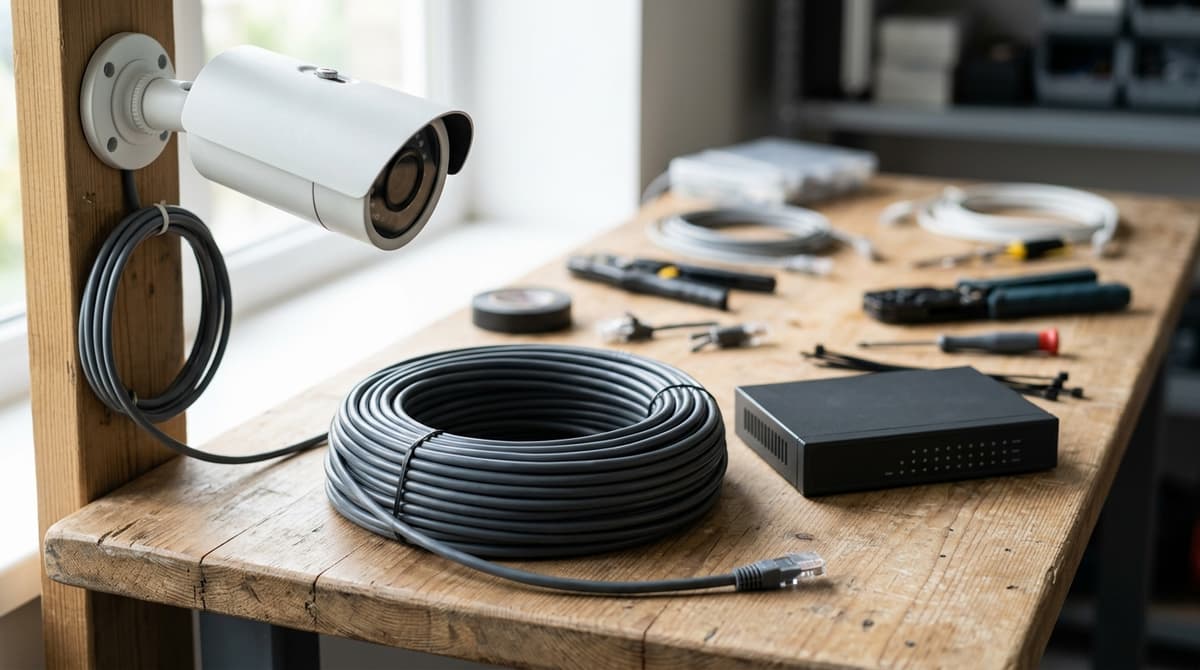
A 50m Cat5e run sits well inside the standard's rated distance and will typically carry Gigabit data and PoE without issue for a single fixed camera — the qualification is that voltage drop, not cable length or data speed, usually decides whether a PoE camera actually gets enough power at the far end. Get that sum wrong on higher-draw devices like PTZs, and the cable can still "work" while the camera browns out or reboots under load.
Cat5e Cable 50m for CCTV: PoE Voltage Drop, Costs and When It's Not Enough
A 50m Cat5e run sits comfortably inside the 100m Cat5e/Cat6 channel limit that structured cabling standards commonly specify, so for most single-camera PoE installs the length itself isn't the problem. The real question at 50m isn't "will it connect" but how much power actually reaches the camera once cable resistance is factored in — and that's where installs come unstuck.
PoE voltage drop at 50m
A 50m Cat5e run uses half of the standard 100m channel budget, so voltage drop is real but manageable for a single PoE camera. Many outdoor and external-grade solid-core Cat5e reels use 24AWG solid copper conductors — Kenable's external Cat5e reel states full copper 24AWG construction, and CCTVLine's own Excel and Connectix external stock is also solid copper. Solid copper carries PoE current more efficiently than the copper-clad aluminium (CCA) sometimes found in budget indoor patch leads, so specifying solid copper matters more at 50m than at 5m.
Voltage drop accumulates with distance and with the number of PoE devices sharing a switch's power budget. A camera at the far end of a long run, or on a switch already near its PoE ceiling, is more exposed than one on a short patch cable. Check the switch's per-port and total PoE wattage rather than assuming length alone is the limiting factor.
Indoor vs outdoor cable at 50m
Indoor-rated Cat5e is not the same product as outdoor Cat5e, and running the wrong one outside is a common 50m CCTV mistake. Outdoor and external-grade Cat5e uses a UV-resistant PE or LDPE sheath rather than standard PVC.
That's why CCTVLine's Connectix External Cat5e UTP Solid Cable and the Excel Cat5e 305m External U/UTP box are both PE-sheathed and Fca euroclass rated for building-to-building CCTV runs. If a 50m drop needs to cross open air, run alongside a wall, or bury a short section, use an external-rated cable rather than an indoor reel bought on the assumption that any Cat5e will do outside.
Cat5e vs Cat6 at 50m: what actually drives cost
Cat5e is commonly rated to 100MHz of bandwidth, while Cat6 is built for higher bandwidth headroom — but for a single PoE camera's bitrate, that extra headroom rarely matters at 50m. Cat6 itself is unshielded by default (U/UTP); shielded variants (S/FTP, F/UTP) exist as separate options rather than being inherent to the category.
The cost difference comes down to copper volume and shielding choice rather than raw speed, so for CCTV-specific runs the sensible comparison is Cat5e vs Cat6 on conductor grade and outdoor sheathing, not theoretical throughput. CCTVLine's trade pricing is shown to logged-in account holders — open an account or browse stock at cctvline.co.uk to see live figures.
When 50m isn't enough
If the actual cable path — accounting for vertical runs, containment bends and slack — pushes past the 100m channel limit once you add patch leads at both ends, 50m of Cat5e stops being the right tool. At that point you need either a PoE extender/repeater or a fibre backbone instead.
For multi-camera sites needing several 50m-plus drops, buying from a 100m reel such as the Connectix External Cat5e 100m LDPE or a 305m pull box works out more practical than sourcing individual pre-terminated 50m leads for each camera. Stock ships UK-wide from CCTVLine's base at 305 Holbrook Lane, our Coventry base, CV6 4DG — get in touch or check the live catalogue for current lead times.
Does a 50m Cat5e cable work for a PoE CCTV camera?
Yes — 50m sits comfortably inside Cat5e's rated range, but voltage drop, not data speed, is what actually limits PoE camera performance at that distance. Structured cabling standards commonly specify a 100m channel limit for Cat5e, so a 50m run leaves half the permitted length spare for both signal integrity and PoE delivery under IEEE 802.3af/at.
Data throughput isn't the constraint here. Cat5e supports Gigabit Ethernet across the full 100m channel, so at 50m there's ample margin for clean signal even on busy sites with multiple patch panels or joints in the run.
PoE behaves differently to plain data. Many outdoor/external solid-core Cat5e reels use 24AWG solid copper conductors — for example, the kenable outdoor Cat5e reel states this gauge — and that gauge has meaningfully higher resistance than thicker structured-cabling conductors. The voltage lost along the copper rises with both distance and the current the camera draws, which is why choosing the right RJ45 connectors and cable termination matters for PoE reliability.
A single fixed-lens camera drawing modest power rarely runs into trouble at 50m. A PTZ dome pulling more current, or several cameras daisy-chained through an unmanaged switch, is where installers more often see cameras reboot intermittently or fail to reach full IR range on cold nights.
What actually protects a PoE run at 50m
- Use solid copper, not CCA. Copper-clad aluminium has notably higher resistance than full copper, so it degrades PoE voltage faster over the same distance — genuine solid copper Cat5e, like the Cat5e External UTP Cable 305m Solid Core, is the safer choice for outdoor camera feeds.
- Match the PSU to the camera's PoE class, not just to "PoE-compatible" — under-specced injectors compound voltage drop rather than absorb it.
- Keep terminations clean. A poor RJ45 crimp or a damp outdoor gland adds resistance exactly where you can't easily diagnose it later.
- Prefer external-grade cable outdoors. A run described as ethernet cable 50m outdoor should carry a UV-resistant LDPE or PE sheath rather than indoor-rated PVC, which degrades in sunlight over time.
For a straightforward fixed camera at 50m, standard external Cat5e — such as the Excel Cat5e 305m External U/UTP Cable, PE Black cut to length, or a dedicated 50m reel — is generally sufficient. Where the load is heavier or the run pushes toward 100m, stepping up to Cat6 cable or splitting the run with a PoE switch partway along typically reduces the voltage-drop risk rather than relying on Cat5e alone.
How much voltage does a 50m Cat5e cable actually lose feeding a PoE camera?
A low-power fixed camera at 50m loses only a small, usually harmless amount of voltage over solid 24AWG Cat5e; a high-draw PTZ or a heater/wiper-equipped housing can lose enough to trip an undervoltage fault. The physics is Ohm's law applied to the loop resistance of whichever conductor pairs are carrying power out and back — resistance rises with length, and volts lost rises with both that resistance and the current the camera actually draws.
More current or more distance, more volts lost in the copper before it reaches the camera's PoE input — the two variables multiply, not add. A camera drawing a few watts barely troubles a 50m run; a 25W-class PTZ with heater pushes far more current down the same pair, and the drop scales accordingly. This is why spec sheets separate "PoE and cable calculator" from "PoE+" and "PoE++" draw figures — the wattage class tells you how hard the copper is working.
A typical PoE switch or injector outputs around 48V nominal, and the camera's onboard PoE module needs enough headroom above its minimum operating voltage once that drop is subtracted. Cable quality matters here: genuine solid-copper 24AWG conductors — rather than copper-clad aluminium — hold resistance closer to datasheet figures and keep drop predictable at full 50m runs, as flagged by suppliers who explicitly state "we don't sell CCA" on their Cat5e solid copper listings.
Practical takeaways for installers
- Run 50m Cat5e with genuine solid-copper 24AWG conductors, such as the Connectix Cat5e External UTP Solid Copper 100m LDPE, rather than budget CCA stock, to keep loop resistance close to spec at full length.
- For heater- or PTZ-class cameras near the 50m mark, favour a PoE+ or PoE++ switch output rather than a basic PoE injector, so there's more voltage headroom to spare after drop.
- If a camera intermittently reboots or shows a low-power warning only on the longest run in a site, suspect voltage drop before suspecting the camera itself — check conductor type and run length first.
The single takeaway: at 50m on genuine 24AWG solid copper, voltage drop is rarely the limiting factor for standard PoE cameras, but it becomes a real design constraint the moment you add PTZ motors or heaters into the load. For trade stock of solid-copper external Cat5e suitable for these runs, browse cctvline.co.uk or open a trade account at cctvline.co.uk/account.
Cat5e vs Cat6 vs Cat7/Cat8 at 50m: which do you actually need?
For a 50m CCTV or PoE run, Cat5e and Cat6 both work fine; Cat7 and Cat8 solve bandwidth problems that most CCTV installs simply don't have. Structured cabling standards commonly specify a 100m channel limit, and Cat5e's rated bandwidth of up to 100MHz is ample for Gigabit Ethernet over a 50m link.
Where each category earns its keep
Cat5e handles full Gigabit to the standard 100m maximum, so a 50m external run is well inside its working envelope for a single IP camera or PoE device.
Cat6 steps up to 250MHz of rated bandwidth, giving more margin on a busy backbone and better support for 10G Ethernet. That said, 10G over Cat6 generally needs a shorter run than the 100m Cat5e/Cat6 ceiling to hold reliably — the exact distance depends on the cable and installation conditions, so check the manufacturer's datasheet rather than assuming 50m is always safe.
Cat7 and Cat8 push into higher shielded bandwidths intended for 10G-plus over short distances in data-centre-style environments. That's rarely what a single-camera or small-NVR install at 50m actually needs.
| Category |
Rated bandwidth |
50m suitability for CCTV/PoE |
Typical use case |
| Cat5e |
Up to 100MHz |
Full Gigabit to 100m; fine for IP cameras up to several megapixels |
Standard CCTV runs, budget installs |
| Cat6 |
Up to 250MHz |
Gigabit with more margin; 10G possible but often needs shorter lengths depending on cable/conditions |
Backbone runs, future-proofing |
| Cat7/Cat8 |
Higher shielded bandwidths, typically for 10G+ over short distances |
Overkill for typical single-camera IP runs at 50m |
Data-centre or high-density switching |
For the vast majority of 50m CCTV and PoE drops, Cat5e delivers the bandwidth the camera actually uses. Paying for Cat6's extra headroom or Cat7/Cat8's shielded bandwidth rarely changes real-world performance at this length. Where Cat6 does make sense is a shared backbone feeding several PoE switches, or a site where 10G uplinks are already planned.
Conductor quality matters more than category at this length
At 50m, full copper conductors matter more to reliability than chasing a higher category number. A solid-core 24AWG Cat5e cable — the construction used in many outdoor/external reels, including Kenable's external Cat5e stock — will typically outperform a higher-rated cable built with copper-clad aluminium.
Trade stock such as the Excel Cat5e 305m External U/UTP Cable, PE Black uses solid copper cores rather than CCA, which keeps PoE voltage drop and signal loss predictable over a 50m outdoor pull. Installers weighing ethernet cable 50m cat6 against a Cat5e outdoor reel should check conductor material on the datasheet before comparing category numbers, since a cheap CCA "Cat6" can underperform a genuine copper Cat5e cable at the same length.
If a project genuinely calls for ethernet cable 50m cat7 or ethernet cable 50m cat 8 — dense switching cabinets or 10G links — that's a different spec conversation from a typical CCTV drop. It's worth confirming against the installed switch and camera hardware first.
For everything else, a trade account at CCTVLine gives access to Cat5e stock in outdoor-rated and indoor gradings, without paying for bandwidth a single IP camera will never use.
Recommended kit
For the setup above, this is the kit we'd recommend from our own range:
- Cat5e External UTP Solid Cable 305m Pull Box — Connectix Cat5e external UTP solid cable for outdoor CCTV and LAN. 305m pull box, CPR Fca rated, black LDPE sheath, supports Gigabit Ethernet and PoE backbone runs.
- Excel Cat5e 305m External U/UTP Cable, PE Black — Excel Cat5e 305m box, external-grade PE sheath, solid copper U/UTP, Fca euroclass rated. Suitable for CCTV, PoE and VoIP runs. Trade stock at CCTV Line, Coventry.
- Cat5e External UTP Cable 305m Solid Core — Cat5e external UTP network cable for outdoor installations with LDPE sheath. Solid core conductors, weather-resistant, suitable for building-to-building
- Connectix Cat5e External UTP Solid Copper 100m LDPE — Connectix External Cat5e UTP cable with solid copper conductors, black LDPE sheath, and 100m outdoor reel for Gigabit networks and CCTV.