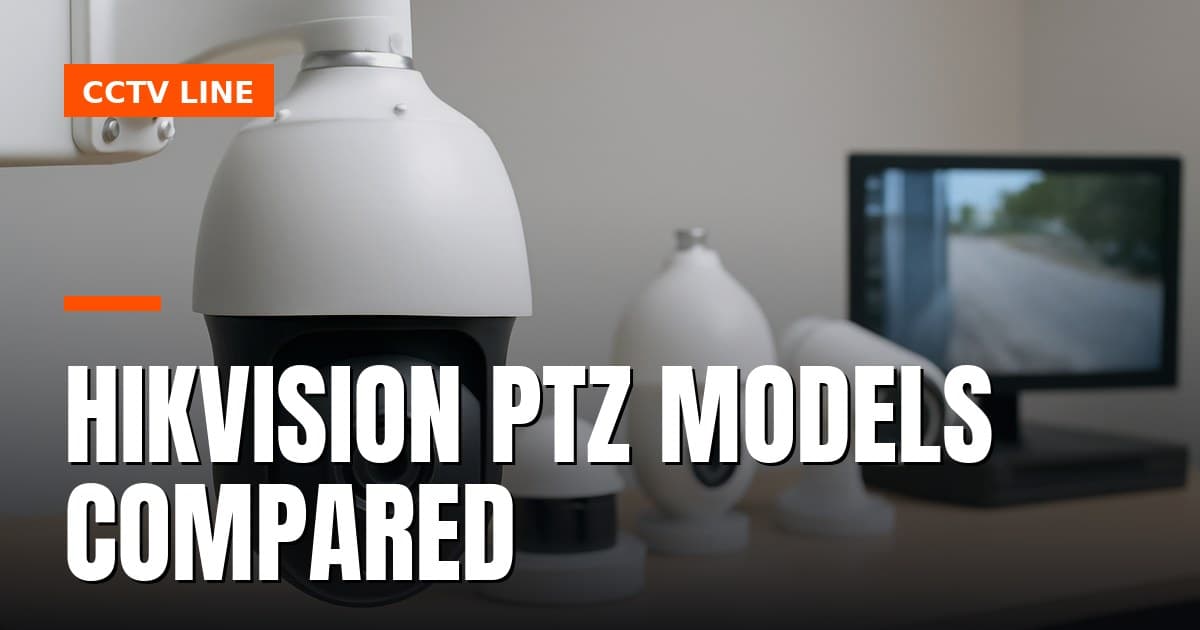
A PTZ security camera — pan, tilt, zoom — uses a motorised head and optical zoom lens to actively move and magnify, letting a single unit cover ground that would otherwise demand four or more fixed cameras. For UK installers, that trade-off is the whole conversation: one Hikvision PTZ camera can surveil a logistics yard or retail car park with genuine operational flexibility, but it also means one motor assembly that will eventually wear, one stream that can only point in one direction at a time, and a proportionality argument you'll need to make clearly under the ICO's CCTV Code of Practice.
What Is a PTZ Camera — and Why Does It Matter for UK Installations?
A PTZ camera is a motorised surveillance unit combining a pan-tilt head (which physically rotates the camera body) with an optical zoom lens, all controllable in real time. The abbreviation stands for pan, tilt, zoom — three distinct mechanical and optical axes that together let a single camera cover ground that would otherwise demand several fixed units.
How PTZ Control Actually Works
Control signals travel to the camera via one of two routes. Legacy analogue PTZ cameras — including HD-TVI models such as the Hikvision DS-2AE5232TI-A — use RS-485 serial wiring running Pelco-D or Pelco-P protocols, where a controller or DVR sends positional commands over a twisted pair. Modern IP PTZ cameras communicate over standard Ethernet using ONVIF Profile S or Hikvision's own SDK, meaning a single Cat6 run carries both video and control.
This distinction matters on site. RS-485 installs require a dedicated data cable alongside the coax or power run, adding labour cost. IP PTZ cameras can share infrastructure with the rest of your network, and many mid-range models accept PoE+ (IEEE 802.3at, 30 W) — though higher-end units with integrated heaters and fast-moving motors often demand a separate 24 V AC or 36 V DC supply.
PTZ vs PTRZ — a Confusion Worth Clearing Up
A category that frequently gets conflated with true PTZ is PTRZ — pan, tilt, roll, zoom — represented by motorised varifocal domes such as the Hikvision DS-2CD2746G2H-IPTRZS2U. These are fundamentally different products. A PTRZ dome uses motor-driven lens adjustment to remotely correct the camera's field of view and rotation angle after mounting, but it does not continuously pan or tilt in real time during operation. It is a commissioning convenience tool, not a tracking camera. Specifying a PTRZ dome where active surveillance is required is a common and costly mistake.
True PTZ cameras — Hikvision's DS-2DE, DS-2DF, and DS-2PT series — deliver 360° continuous pan (no mechanical stop), ±90° tilt, and optical zoom ranging from 4× on compact units up to 40× and beyond on long-range models. That 40× optical zoom is genuine glass-and-motor magnification, not digital cropping, which preserves image quality at distance in a way that no fixed or PTRZ camera can replicate.
What "PTZ on Hikvision" Means in Practice
Hikvision's PTZ lineup spans several tiers relevant to UK installations. At the accessible end, the DS-2DE series covers general-purpose IP PTZ use with 20× to 32× zoom and Smart IR illumination reaching 100 m or more. The DS-2DF series steps up to higher-resolution sensors and faster preset speeds — some models move between presets in under one second using Hikvision's Rapid Focus 2.0 technology. The flagship DeepinViewX range, powered by Hikvision's Guanlan AI engine, claims video content analysis (VCA) detection ranges of up to 400 m and a 90%+ reduction in false alarms compared to conventional AI cameras, according to Hikvision's own lab testing. These 8 camera kits represent the most common deployment configuration for mid-sized commercial sites, though 25 camera kits are increasingly specified for larger estates.
Preset positions are stored on-camera (typically 300 or more presets per unit) and recalled via the NVR, VMS, or a dedicated keypad module. Patrol paths and scheduled tours run autonomously without operator input, which is relevant when you're designing an unmanned remote site.
The Core Trade-Off: Coverage vs Single Point of Failure
One
How Do Hikvision's Current PTZ Series Stack Up? (Model Matrix by Job Type)
The right Hik PTZ camera depends on three things: resolution requirement, power infrastructure, and budget. Picking the wrong series costs you either a revisit to upgrade or money spent on capability the site will never use.
The Main UK-Stocked Series at a Glance
| Series |
Resolution |
Optical Zoom |
IR Range |
Key Tech |
Power Input |
IP Rating |
UK Trade Price Tier |
| DS-2DE4A |
4 MP |
25× |
100 m |
Standard IR |
PoE+ (802.3at) |
IP66 |
£ |
| DS-2DE7A |
2 MP or 4 MP |
20–32× |
100 m |
ColorVu or AcuSense |
24 V AC / PoE++ |
IP66 |
££ |
| DS-2DF8 |
4 MP |
25–42× |
200 m |
DeepinView, standard IR |
24 V AC |
IP66 |
£££ |
| DS-2AE5232 |
2 MP (HD-TVI) |
32× |
150 m |
Standard IR, analogue |
24 V AC |
IP66 |
£ |
These four series cover the vast majority of UK installs. Each is discussed below by the job type it suits best.
DS-2DE4A — Value IP PTZ for Straightforward Sites
The DS-2DE4A is the workhorse entry-level IP PTZ in Hikvision's current UK lineup: 4 MP resolution, 25× optical zoom, and 100 m Smart IR, all powered over a standard PoE+ (802.3at) switch port. That PoE+ compatibility is the biggest practical advantage — no separate power run, no 24 V AC transformer, just a Cat 6 cable to a switch with a 30 W per-port budget.
It suits car parks, retail yards, and school perimeters where you need optical zoom and reasonable IR reach without the cost of mid-range analytics. Standard IR means no colour-at-night performance; if the site has no ambient lighting, shortlist the DE7A ColorVu variant instead.
DS-2DE7A — The Pro IP Series for Most Commercial Jobs
The DS-2DE7A is the series most UK installers reach for on commercial contracts: available in 2 MP or 4 MP, 20× to 32× zoom depending on variant, with ColorVu (full-colour low-light) or AcuSense (human/vehicle classification) sensor options. IR range stays at 100 m, matching the DE4A, but the sensor and processing capability is a significant step up.
Power input is 24 V AC or PoE++ (802.3bt, up to ~60 W), so check your switch port budget before specifying PoE delivery on the higher-zoom variants — a 32× DE7A with heater draws more than a standard 802.3at port provides. The ColorVu variant is the right call for sites with some ambient light but poor contrast; AcuSense suits perimeter detection where false alarm reduction from foliage or animals is the client's main concern.
DS-2DF8 — Ultra/DeepinView for Long-Range and Critical Infrastructure
The DS-2DF8 series steps up to 4 MP with 25× to 42× optical zoom and doubles the IR range to 200 m — the meaningful differentiator for large industrial sites, ports, or open land where targets are small at distance. Power is 24 V AC only; there is no PoE option at this tier, so budget for a local power supply or transformer at every mounting point.
Deep
AcuSense vs ColorVu vs Standard IR: Which Technology Fits Which UK Site?
Choose the technology based on what the site demands evidentially and operationally. AcuSense suits alarm-response perimeters, ColorVu suits colour-evidence environments, and standard IR suits low-cost or covert applications. Getting this wrong costs money in false call-outs or ICO compliance issues.
AcuSense: Perimeter, Car Parks and Logistics Yards
AcuSense classifies targets as human or vehicle at the point of detection, rather than relying on pixel-change motion. That distinction is what makes it genuinely useful for alarm-receiving-centre (ARC) response under NSI and SSAIB-graded schemes, where nuisance alarms directly affect your site's alarm response category.
On a busy logistics yard, a standard motion-triggered PTZ will alarm on blowing debris, passing headlights, or a fox crossing the compound. AcuSense filters those out and triggers only on confirmed human or vehicle intrusion, with the option to fire a strobe and audible warning from the camera itself — a first-line deterrent before a guard is dispatched.
The DS-2DE7A220MCG-EB combines AcuSense with ColorVu in a single 20× PTZ body, making it the go-to specification for sites that need both classification and full-colour evidence. It is worth noting that this camera uses supplemental white-light LEDs rather than IR, so the technology choice is already made for you on that model.
For pure AcuSense without white light, the DS-2DE4 and DS-2DF8 series units with the /S or /G2 suffix carry the classification engine with IR illumination. These are the better fit for perimeter lines where you want silent, invisible detection with classification — the strobe and audio warning can still be triggered on confirmed events without betraying the camera's position during routine surveillance.
Best-fit sites for AcuSense:
- Industrial perimeters and logistics yards (reduces ARC call-out costs)
- Car parks requiring vehicle/person separation for access-control integration
- Any site on an NSI Gold or SSAIB-graded alarm response contract where false-alarm limits apply
- Retail distribution centres where after-hours intrusion must be confirmed before guard dispatch
ColorVu: Retail Frontages, Forecourts and Town-Centre Deployments
ColorVu delivers full-colour imagery around the clock using a large-aperture lens combined with supplemental white-light LEDs — there is no invisible IR here. The result is footage that retains clothing colour, vehicle colour, and facial detail in conditions where a standard IR camera would produce a monochrome image.
Under Crown Prosecution Service (CPS) guidelines, colour evidence materially strengthens identification. A grey-scale image of a suspect in a distinctive red jacket is evidentially weaker than a colour image — and that difference can affect charge decisions. For retail frontages, petrol forecourts, and town-centre deployments where footage is routinely submitted to police, ColorVu is the specification that matters.
The white-light flash is visible to subjects. That is not a flaw — on a forecourt it acts as a deterrent — but it carries ICO and UK GDPR implications. The ICO's CCTV code of practice requires that surveillance is proportionate and that subjects are made aware they are being monitored. Visible white-light activation counts as active surveillance, so your DPIA must address it, and signage must be prominent and compliant with the ICO's recommended wording and placement standards.
On the DS-2DE7A220MCG-EB specifically, the ColorVu and AcuSense functions are combined: the white-light LEDs fire when AcuSense confirms a human or vehicle, rather than on every motion event. That proportionality is useful for DPIA justification
— it demonstrates that you are not conducting blanket surveillance but targeting specific threat categories. The DS-2DE7A220MCG-EB therefore offers a pragmatic middle ground for high-street and retail environments where compliance and evidential quality must both be demonstrated to stakeholders and regulators.
Matching the Right Hikvision PTZ SKU to Your Job Type: A Practical Decision Guide
The single biggest mistake on PTZ projects is specifying by price rather than by use case. Pick the wrong SKU and you'll either overspend on analytics nobody needs or, worse, deploy a camera that can't deliver evidential colour footage at the range the site actually demands.
Car Parks and Retail: DS-2DE7A220MCG-EB (ColorVu, 20×, AcuSense)
Best for: multi-storey car parks, retail forecourts, drive-throughs — anywhere colour evidence at night is non-negotiable.
The DS-2DE7A220MCG-EB is Hikvision's mainstream IP PTZ for medium-range colour work. Its ColorVu sensor produces full-colour imagery in near-zero light without relying on IR, which means number plates and clothing colours are usable as evidence rather than greyscale guesswork.
AcuSense onboard classifies targets as human or vehicle, cutting nuisance alerts from blowing litter or headlight wash — a genuine daily problem on retail sites. The camera accepts PoE++ (IEEE 802.3bt, up to 60 W) or 24 V AC, so you can run it from a high-power PoE switch without a separate transformer if your cable run is within spec.
At 20× optical zoom it covers a typical 200-space car park from a single corner pole. UK trade pricing requires a login at most distributors (CCTV Direct, Norbain, Videcon), but budget in the mid-hundreds of pounds at trade — it sits firmly in the mid-market IP PTZ bracket.
Installation note: PoE++ budget matters here. Confirm your switch port delivers the full 60 W; undersupply causes erratic pan/tilt behaviour that's easily misdiagnosed as a camera fault.
Perimeter and Industrial: DS-2DF8 Series (25–42×, IR, AcuSense)
Best for: industrial estates, utility sites, logistics yards — long perimeters where detection range, not colour, is the priority.
The DS-2DF8 series covers 25× to 42× optical zoom depending on the specific variant, with Smart IR reaching 200 m. Hikvision's DeepinViewX specification quotes VCA (video content analysis) detection range up to 400 m, which is the figure to use when planning camera spacing on a long fence line.
Auto-tracking locks onto a classified target and follows it without operator input — critical for lone-operator control rooms covering large sites. False alarm suppression is quoted at 90%+ reduction versus conventional AI cameras in Hikvision's own lab testing, which is worth factoring into your monitoring contract costs.
Power is 24 V AC only on most DS-2DF8 variants — there is no PoE option at this power class. Budget for a dedicated transformer, correct cable sizing for the run length, and a weatherproof enclosure rated to at least IP66 per BS EN 60529. On exposed industrial sites, IK10 vandal resistance is worth specifying too.
Key planning figure: 400 m VCA range means one DS-2DF8 PTZ can cover what might otherwise need three or four fixed cameras on a straight fence run.
Analogue Retrofit / Existing Coax: DS-2AE5232TI-A (HD-TVI, 32×, 150 m IR)
Best for: sites with existing coaxial infrastructure and a working DVR — schools, small industrial units, legacy retail estates.
The DS-2AE5232TI-A transmits HD-TVI over coax, which means no NVR, no IP switch, and no re-cabling. It delivers 32× optical zoom and 150 m Smart IR over the
same cable that powers it. Installation is straightforward: connect to your existing DVR's analogue input, and the camera handles both video and power delivery without additional infrastructure. This makes it ideal for retrofitting surveillance into older systems where budget constraints or building regulations prevent a full IP migration.
This article was researched and written by IT Master.