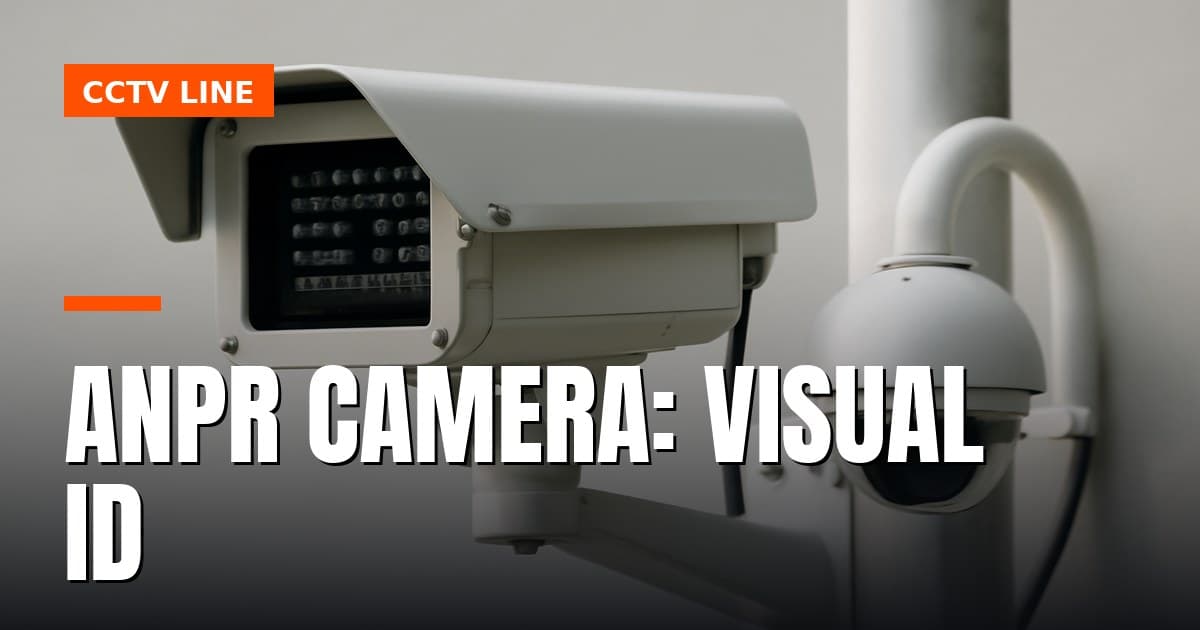
An ANPR camera is built to do one job — read a number plate cleanly — and that engineering purpose makes it immediately recognisable to a trained eye. Unlike the compact domes and turrets that dominate general CCTV installations, a fixed ANPR unit typically presents as a long-barrel bullet or box housing, often 250–400 mm in length, with a narrow-angle lens and a distinctive ring or array of infrared LEDs tuned specifically to illuminate retroreflective plate material. Once you understand that every physical feature is a direct consequence of the optics required to capture a sharp, OCR-readable plate image at vehicle speed, identifying one on a gantry or gatehouse post becomes second nature.
What Does an ANPR Camera Look Like? The Physical Characteristics That Identify One
An ANPR camera is immediately recognisable once you know what to look for: it uses a long-barrel bullet or box housing, a narrow-angle lens, and a prominent infrared illuminator — a combination dictated entirely by the physics of reading a number plate at 30–70 mph.
Fixed roadside ANPR units almost always use a bullet or box-style housing, typically 250–400 mm in length. That extended barrel is not cosmetic — it houses a longer focal-length lens and keeps the IR illuminator co-axial with the optical axis, which is essential for triggering the retroreflective material in a UK-standard number plate.
You will not see a dome or turret housing on a purpose-built ANPR camera. Domes are designed for wide-area scene coverage; ANPR requires a tight, precisely aimed field of view with no internal reflections from a dome cover that would degrade OCR accuracy.
Mobile police ANPR units are a different form factor entirely — compact wedge or pod-shaped modules, typically mounted on the roof bar or boot lid of a patrol vehicle. These are engineered to read plates on passing or oncoming traffic at relative speeds that can exceed 100 mph, so the housing is aerodynamic and vibration-damped.
Lens and Focal Length
Fixed ANPR cameras almost always use a narrow field-of-view lens — typically in the 8 mm to 50 mm range, varifocal or motorised — rather than the wide 2.8 mm or 4 mm lenses common on general CCTV turrets and camera systems. The longer the read distance, the longer the focal length required: a camera covering a single lane at 6–10 metres might use an 8–12 mm lens, while a motorway gantry unit reading at 20–30 metres will be closer to 35–50 mm. Correct ANPR camera installation ensures that lens selection matches the deployment distance precisely, maximising read accuracy and minimising OCR failures.
This narrow field of view is why ANPR cameras look like they are "pointing" at a very specific spot on the road rather than surveying a broad area. Each camera covers one lane; a three-lane carriageway needs three cameras, each precisely aimed.
Infrared Illuminator
The most visually distinctive feature of an ANPR camera is its IR illuminator array. On a fixed unit you will typically see a ring or rectangular bank of high-power IR LEDs surrounding the lens aperture, often appearing as a dark red or black panel in daylight. At night these emit 850 nm or 940 nm near-infrared light — invisible to the human eye but intensely bright to the camera sensor.
The illuminator is sized to match the lens angle precisely. A mismatch between illuminator beam angle and lens field of view produces hot-spots or dark edges on the plate image, causing OCR failures. This tight integration is why the illuminator is always built into the same housing rather than added as a separate unit.
Mounting Position and Aim Angle
ANPR cameras are mounted at a specific height and angle to achieve the correct plate presentation. The Home Office guidelines used by UK police recommend a camera height of 1.0–1.5 metres for front-plate capture and a horizontal aim angle of no more than 30° from the vehicle's direction of travel. Exceeding that angle introduces keystoning that degrades character recognition.
In practice, fixed enforcement cameras are typically pole-mounted at 1.2–1.5 m on the nearside of the lane, angled slightly inward. Gantry-mounted units on motorways sit higher — sometimes 5–6 metres — and use a steeper depression angle with a correspondingly longer focal length to compensate.
Colour and Weatherproofing
Most fixed ANPR housings are finished in grey, black, or yellow RAL colours depending on the operator. Highway authority and police units in the UK are frequently yellow, which is a deliberate visibility choice rather than a technical requirement. Private car park and retail installations typically favour discrete grey or black finishes to blend into their surroundings. All professional ANPR cameras are sealed to IP65 or higher standards, protecting internal optics and circuitry from dust, moisture, and temperature fluctuations across seasons. Stainless steel or powder-coated aluminium housings resist corrosion in coastal and high-pollution environments, while internal heating and cooling systems maintain optimal sensor performance in extreme weather conditions.
How Does an ANPR Camera Work? The Optical and Processing Pipeline Explained
An ANPR camera works by combining a high-speed optical capture stage with on-board OCR or deep-learning recognition, completing the full read cycle in well under 100 milliseconds. Every component — shutter, illuminator, sensor, and processor — is tuned specifically for that single task.
The Capture Stage: Freezing a Moving Plate
The fundamental engineering challenge is motion blur. A vehicle travelling at 30 mph covers roughly 13 metres per second; at 70 mph that rises to 31 m/s. At a standard CCTV shutter speed of 1/50 s, a plate at 30 mph would smear across more than 26 cm of real-world distance — completely unreadable.
ANPR cameras counter this with shutter speeds typically between 1/1,000 s and 1/10,000 s, reducing motion blur to a millimetre or less even at motorway speeds. That extremely short exposure window demands a lot of light, which is why the IR illuminator arrays fitted to ANPR housings are so much more powerful than those on a standard turret camera.
Infrared Illumination: Why It Dominates ANPR
Most ANPR cameras operate in the near-infrared band, typically 850 nm, with some using 940 nm for covert operation where the faint red glow of 850 nm LEDs would be conspicuous. UK number plates are manufactured with retro-reflective material that bounces IR back toward the camera far more efficiently than ambient white light does.
This retro-reflectivity is why IR illumination produces such high-contrast plate images — the characters appear almost black against a brilliant white background. The camera's IR-cut filter is either removed entirely or switched out during plate capture, allowing the sensor to work in its most sensitive spectral range.
Sensor and Resolution Requirements
ANPR sensors are optimised for contrast and sharpness rather than colour fidelity or wide dynamic range in the conventional sense. The sensor must resolve individual characters on a standard UK plate — characters are 79 mm tall and 50 mm wide — at distances that can exceed 10–15 metres depending on the installation.
A useful rule of thumb in the industry is that you need a minimum of around 40 pixels across the width of a character for reliable OCR; dedicated ANPR cameras are engineered to deliver this across their full operating range. General-purpose IP cameras, even high-resolution ones such as the 8 MP or 12 MP turret cameras used for scene overview, are not optimised for this narrow task — their auto-exposure and colour processing pipelines actively work against the high-contrast, near-monochrome image an ANPR engine needs.
On-Board Processing: OCR and Deep Learning
Once the sensor captures a correctly exposed frame, the image is passed to an on-board processor running either classical OCR algorithms or, increasingly, a convolutional neural network trained specifically on plate fonts and layouts. Classical OCR segments the image into individual characters and matches each against a trained character set; it is fast and predictable but can struggle with partial occlusion or non-standard plates.
Deep-learning engines treat plate reading as an end-to-end recognition problem, often achieving higher accuracy on dirty, angled, or partially obscured plates. NVRs with AI capability — such as those supporting "AI by Camera" analytics — can receive the pre-processed plate string directly from the camera rather than re-processing raw video, which reduces NVR load significantly. The camera transmits both the cropped plate image and the decoded alphanumeric string as structured metadata alongside the video stream.
The Full Pipeline in Sequence
| Stage |
What happens |
Typical time budget |
| Trigger |
Loop detector, radar, or video motion detects approaching vehicle |
< 5 ms |
| Illuminator fire |
IR array pulses at full power for the exposure duration |
0–50 μs |
| Capture |
Sensor records the plate region at high resolution and contrast |
10–100 μs |
| Preprocessing |
Raw image buffered; hot pixels removed; contrast normalized |
1–5 ms |
| Plate detection |
Neural network or template matching locates plate boundaries |
5–20 ms |
| Character segmentation |
Individual digits and letters isolated within the plate region |
2–10 ms |
| OCR recognition |
Deep learning model reads each character and assigns confidence scores |
10–50 ms |
| Database lookup |
Plate string queried against watchlists, registration records, or alerts |
5–100 ms |
| Output & logging |
Match result (hit/no-hit) recorded with timestamp, image, and metadata |
< 1 ms |
The entire sequence typically completes in 50–300 milliseconds, allowing systems to process dozens of vehicles per minute even in high-traffic scenarios. Modern ANPR installations often run multiple parallel pipelines to handle peak flow without bottlenecks.
What Does an ANPR Check? What Police and Private Systems Actually See
ANPR does not simply photograph a number plate — the moment a Vehicle Registration Mark (VRM) is decoded, it is cross-referenced against multiple live databases simultaneously, typically within one to two seconds of the vehicle passing the camera.
What Police ANPR Checks in Real Time
When a police-operated ANPR camera reads a plate — whether from a fixed roadside unit, a mobile deployment, or a camera mounted on a patrol or unmarked vehicle — the VRM is automatically queried against several databases at once:
- Police National Computer (PNC): Flags stolen vehicles, vehicles of interest, and keepers with outstanding warrants or intelligence markers.
- DVLA vehicle register: Confirms the vehicle is registered and matches the make, model, and colour on record — a mismatch is itself an alert.
- Motor Insurance Database (MID): Answers the question people search most: yes, ANPR does check insurance, in real time, on every read.
- DVLA VED (road tax) records: Confirms whether Vehicle Excise Duty is paid and current.
- MOT status: Yes, ANPR does check MOT. The system queries DVSA records, so an expired MOT will flag the vehicle immediately — does no MOT show up on ANPR? It does.
- Intelligence flags: A vehicle or keeper may carry a marker for reasons that are not publicly disclosed — drug offences, county lines intelligence, or a subject of interest — which triggers a silent alert to the attending officer.
All of these checks happen automatically, without any officer input, on every single vehicle the camera reads. ANPR does check every car that passes within its capture zone, not a sample.
What Happens When a Flag Is Triggered
A positive hit generates an audible or visual alert on the in-vehicle ANPR terminal or the control room monitor. The officer then decides whether to intercept — the system flags, but a human makes the enforcement decision.
False reads do occur, particularly on dirty, damaged, or non-standard plates, which is why trained officers verify visually before acting. The read itself is not evidence of an offence; it is a prompt to investigate.
What Private ANPR Systems Check
Private systems — car parks, retail sites, industrial estates, housing developments — operate on an entirely different legal basis and have no access to PNC, MID, or DVSA records. What they check is far narrower:
- Dwell time / permitted stay: The system logs entry and exit timestamps and calculates whether the vehicle has exceeded the allowed period. This is the basis for the vast majority of private parking charge notices (PCNs).
- An internal permit or allow/deny list: A site may whitelist resident or staff plates so they are never charged, or blacklist known persistent offenders.
- DVLA keeper lookup (post-event): Private operators accredited by the British Parking Association (BPA) or the International Parking Community (IPC) can apply to the DVLA for keeper data after a potential contravention, at a fee per request. They cannot query insurance, MOT, or tax.
Private ANPR systems do not see anything about the vehicle's roadworthiness, insurance status, or any police intelligence. Their data capture is limited to plate, timestamp, and site location.
Data Retention and UK GDPR Obligations
Police ANPR data is governed by the College of Policing's ANPR Code of Practice. Images and reads from vehicles with no associated hit are typically retained for 12 months on the National ANPR Service (NAS); data linked to an investigation can be held longer under force-specific policies.
Private operators fall under UK GDPR and the ICO's CCTV / surveillance camera code of practice. The ICO's guidance recommends retaining ANPR data only for as long as necessary for the stated purpose — for a car park, that is generally 14 to 28 days after the payment or appeal period has ended. Operators must document their retention schedules, conduct Data Protection Impact Assessments (DPIAs) for high-risk deployments, and ensure individuals are informed via visible signage that ANPR monitoring is in place. Failure to comply with these obligations can result in significant fines and reputational damage.
ANPR Camera vs Standard CCTV: Key Technical Differences for Installers and Buyers
Fitting a standard CCTV camera and expecting reliable plate reads is the single most common — and costly — mistake in access control projects. The hardware differences between a general-purpose camera and a true ANPR unit are fundamental, not cosmetic, and they affect every layer of the specification.
Focal Length and Capture Zone
A wide-angle turret — such as an 8 MP or 12 MP fixed camera with a 2.8 mm lens — produces a horizontal field of view above 100°. That wide cone is exactly what you want for a car park overview or a corridor, but it renders a number plate as a tiny cluster of pixels at anything beyond 3–4 metres — far too small for reliable OCR.
A dedicated ANPR lens sits in the 12 mm–25 mm range, narrowing the FoV to roughly 25°–10° respectively. That compression places the plate large enough in frame for the recognition engine to work at capture distances of 8–15 m, which covers the vast majority of UK entrance and exit lanes.
The correct workflow is: establish your required capture distance first, then back-calculate the focal length. Trying to make a 2.8 mm camera "work" by moving it closer usually creates an oblique angle that defeats OCR just as reliably as being too far away.
IR Illumination Design
| Feature |
General CCTV IR |
ANPR IR |
| Beam pattern |
Wide flood, even scene coverage |
Narrow, high-intensity beam |
| Target |
Ambient scene illumination |
Retroreflective plate material |
| Typical wavelength |
850 nm (visible glow) or 940 nm |
850 nm or 940 nm, higher output |
| Overexposure risk |
Low |
High if gain not managed |
General-purpose IR arrays are engineered to illuminate a broad scene evenly. ANPR IR is a concentrated, high-intensity narrow beam specifically designed to maximise retroreflection off the prismatic material used in UK-standard number plates. That retroreflection bounces light directly back to the lens, making the plate characters pop against the background even in full darkness.
The consequence for installers is that the same IR intensity that produces a perfect plate image will simultaneously blow out a driver's face in the same frame. If your brief requires both plate capture and facial identification from a single camera position, expect to compromise on one or the other — or specify two cameras on the same lane, each optimised for its own task.
Sensor Exposure and Shutter Speed
A standard CCTV camera is tuned for a balanced, natural-looking image across the whole scene. An ANPR camera uses a very fast shutter — typically 1/1000 s or faster — to freeze a vehicle travelling at 5–30 mph without motion blur on the plate characters.
This fast shutter demands either bright IR illumination or a larger sensor with good low-light performance to compensate for the reduced exposure time. It also means the background scene will appear dark or underexposed in the captured frame, which is normal and expected in a correctly configured ANPR image.
Processing: Edge OCR vs. Server-Side
Modern ANPR cameras carry the recognition engine on-board, running OCR at the edge and transmitting structured data (plate string, timestamp, direction, confidence score) rather than raw video. This reduces bandwidth and allows the camera to trigger a barrier, gate relay, or alert in under 500 ms without waiting for a server round-trip.
General CCTV systems — including AI-analytics NVRs that support ANPR "AI by Camera" — rely on the camera or recorder performing the OCR task. That architecture works well for lower-throughput sites, but the camera itself must be specified as an ANPR-capable model with sufficient GPU or edge-compute resources to handle real-time plate recognition. Server-side processing, by contrast, centralizes OCR on a dedicated recognition engine or cloud service, which can be more cost-effective for retrofitting existing camera networks but introduces latency and requires higher bandwidth for video streaming. The choice between edge and server-side OCR ultimately depends on response-time requirements, network infrastructure, and the scale of the deployment.