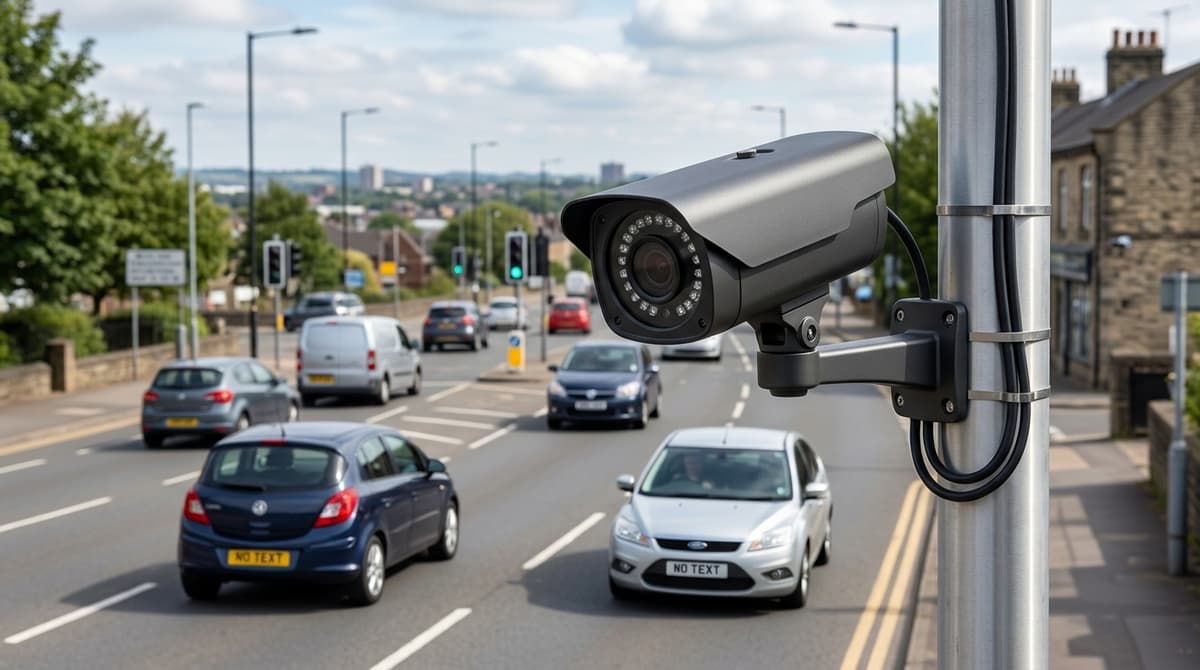
Can a Normal CCTV Camera Read a Number Plate?
Mostly, no — a standard CCTV camera gives you a crisp, watchable picture of a car but still renders the plate as a grey smear. Plate capture depends on pixel density at the plate, shutter speed, and lens geometry lining up together, not on megapixel count alone. That's why dedicated ANPR cameras exist as a distinct product category rather than a setting you switch on.
Get the maths right and even a modest-resolution camera can nail a plate every time. Get it wrong, and a 4K camera won't. This is the single biggest misconception we see from installers new to ANPR: resolution is only one variable, and it's rarely the one that fails first.
A standard CCTV camera cannot reliably read a moving vehicle's number plate, even in good daylight, because it's built to show a wide scene rather than resolve small, high-contrast characters. General observation and plate capture pull the lens, sensor and shutter settings in opposite directions.
Why a wide-view camera and a plate-reading camera can't be the same setting
A wide field of view and a legible plate are pulling against each other on the same lens. A general-purpose camera is set up to cover as much ground as possible, so each object in frame gets relatively few pixels.
A plate only becomes legible once the characters occupy enough pixel height across the sensor, which means narrowing the field of view rather than widening it. That's the core reason a camera watching an entire yard usually can't also give a crisp read on a plate several metres away.
The shutter speed problem
Shutter speed is the second reason a general camera fails on plates, even with the right field of view. Standard cameras are often set to slower shutter speeds to gather more light and keep footage smooth — exactly wrong for a moving vehicle.
A car moving through a gate will blur across the frame at a typical general-surveillance shutter setting, smearing the plate characters into an unreadable streak. Dedicated number plate reading cameras use a fast, fixed shutter to freeze the plate regardless of vehicle speed, which a general observation camera isn't tuned to do.
What has to line up before a plate is readable
Three variables have to be right together at the moment the plate is captured: distance from camera to plate, resolution and pixel density on target, and shutter speed matched to vehicle speed. Get one wrong and the other two don't compensate.
A high-megapixel camera with a slow shutter still blurs a moving car.
How Many Pixels Do You Actually Need to Read a Plate? (Pixel-Density Maths)
Plate-reading isn't about megapixels — it's about pixels-per-metre (PPM) at the plate itself. A 4MP camera on a longer lens will often out-resolve an 8MP camera on a wide-angle lens at the same distance, because resolution only tells you the total pixel count across the sensor, not how that count is spread across the scene once lens angle and distance come into play.
The calculation you can reuse
PPM is worked out as: horizontal sensor resolution (pixels) ÷ horizontal field of view at the target distance (metres). A UK number plate is roughly 0.51m wide.
Once you know the PPM figure, multiply it by 0.51 to see how many pixels actually fall across the plate. That's the number that needs to be enough to separate one character from the next — not just outline the plate as a rectangle.
Why lens choice matters more than sensor size
Widen the field of view to cover more of a car park and you dilute the same pixel count across a bigger area, dropping PPM at any given distance. Narrow the lens and PPM at range goes up even on a lower-megapixel sensor.
In short, the lens does more work for plate legibility than the datasheet resolution figure suggests.
Detection vs identification
Detecting that a vehicle is present and reading its specific characters are two different jobs with very different PPM requirements. A camera set up only to trigger on movement or count vehicles can run at a lower PPM than one expected to output readable characters for a report or database query.
Wikipedia's ANPR overview
What Shutter Speed Do You Need to Stop Number Plate Blur?
Stopping plate blur on a moving vehicle typically needs a shutter speed of at least 1/1000s, far faster than the 1/25s–1/50s a standard camera defaults to after dark. At normal road speeds a plate crosses the camera's field of view in a fraction of a second. Anything slower than roughly 1/1000s smears the characters into an unreadable blur, regardless of sensor resolution.
Why standard night settings work against you
Most general-purpose CCTV cameras are tuned to do the opposite of what plate-reading needs. After dark they automatically drop the shutter speed to hold it open longer, pulling in more light per frame and keeping grain and noise down on a static scene like a driveway or car park.
That's exactly the setting that turns a plate doing any real speed into a pale streak rather than legible characters.
The light-versus-speed trade-off
A faster shutter lets in less light per frame, which is precisely why plate capture and low-light noise performance pull in opposite directions on the same sensor. A camera optimised for smooth, clean night footage of people and general activity is usually under-specified for freezing a plate.
A camera set up to freeze a plate needs to claw back the lost light some other way — typically a larger sensor, a wider-aperture lens, or dedicated infrared illumination timed to the shutter. That's the approach purpose-built ANPR cameras take rather than relying on ambient IR alone.
Key takeaway: a camera that renders a stationary car crisply on a monitor can still turn its plate into an unreadable smear the moment that vehicle is moving at normal road speed — shutter speed, not resolution, is usually the deciding factor.
Why Do Number Plates Disappear at Night — Even With Infrared?
Yes, plates can vanish at night even with infrared switched on — the cause is usually glare, not darkness. Number plates use a retroreflective material designed to bounce a car's own headlights straight back at the driver, and that same reflectivity can overwhelm a standard camera's built-in IR illuminator at close range.
The result is a plate that blows out into a white blob. It's a design feature of the plate working against the camera rather than a camera fault.
A general-purpose IR camera — the type used for perimeter fencing, yards or entrance monitoring — is built to light an entire scene evenly. It isn't built to control glare from one small reflective object a few metres from the lens.
Push IR power up to reach across a car park and a plate at 5–10 metres reflects so much of it straight back that the sensor sees only a bright white rectangle, characters gone. This is the real mechanism behind "number plates invisible to cameras" complaints. It's rarely the plate defeating the camera outright — it's IR angle, distance and reflectivity combining to overexpose the one detail that matters.
This is exactly why a dedicated number plate reading camera — a purpose-built ANPR unit — differs from a standard IR turret or bullet, as covered in our anatomy of what an ANPR camera looks like. The differences typically come down to lens design, IR control, and sometimes sensor filtering.
Key takeaway: darkness alone doesn't kill plate legibility — uncontrolled IR reflecting off a retroreflective plate does, which is why general IR cameras and true ANPR cameras solve the problem so differently.
Standard CCTV vs a Dedicated ANPR Camera: What's Actually Different?
A dedicated ANPR camera is engineered for one fixed point — plate pixel density, shutter speed, and IR tuned for plate reflectivity — while a standard CCTV camera is built for broad scene coverage. That trade-off is why the same car can look perfectly identifiable on a general-purpose bullet camera and come out as an unreadable blur on the same site's entrance lane, if the wrong camera is used for the job.
A general CCTV camera has to do everything reasonably well; an ANPR camera has to do one thing precisely. A standard 2MP turret or dome is designed to cover a doorway, yard or car park in a single wide frame, spreading its pixels across the whole scene. An ANPR unit is calibrated to one lane, one distance and one direction of travel instead.
Every pixel in that fixed frame is working on the plate rather than the background.
Where the engineering diverges
- Pixel density at range: a wide-angle lens covering an entire car park loses resolution on any single plate; an ANPR lens and sensor pairing is matched to a fixed working distance so the plate fills enough of the frame to stay legible.
- Shutter speed: general CCTV shutter settings are tuned for smooth, natural-looking footage of people and static scenes, not for freezing a plate moving at road speed — an ANPR camera's shutter is set against the expected vehicle speed for that specific lane.
- Illumination: standard IR is designed to light a whole scene evenly; ANPR IR (or dedicated white-light) is tuned to the retro-reflective coating on a genuine plate, which is what makes the characters stand out at night rather than washing out or underexposing.
Some models sit in between, with vehicle-detection features built into an otherwise general-purpose camera.