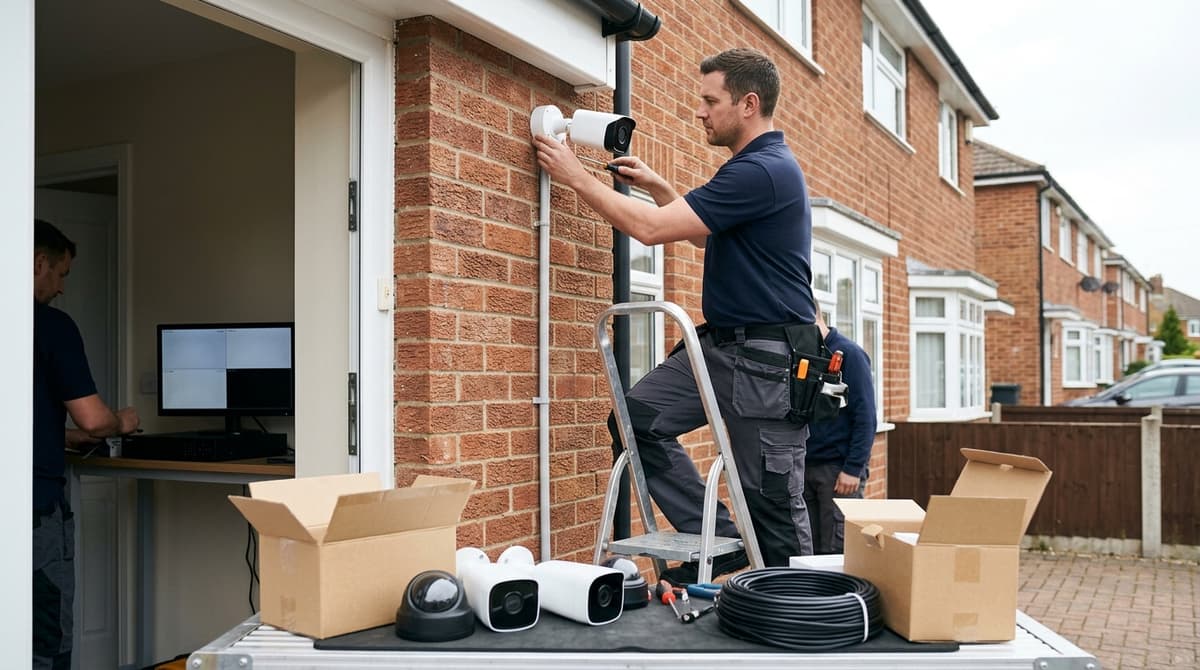
Two quotes for "the same job" rarely price the same job — which is exactly why searching "CCTV installation companies near me" and picking the cheapest name is a gamble most buyers regret. The installer who turns up matters far less than what's behind them: accreditation, insurance, and a quote that actually itemises what you're paying for. Get those three things right before you book, and everything else — camera choice, positioning, price — becomes a much easier conversation.
CCTV Installation Companies Near Me: How to Vet and Choose a UK Installer (2026)
The fastest way to vet CCTV installation companies near me is to compare three things before booking: a written itemised quote, proof of insurance, and how they explain your legal duties as a system operator. A rehashed sales call with a single lump-sum price is the biggest red flag, and it costs nothing to ask for the breakdown in writing.
What a proper quote itemises
A trustworthy quote for cctv camera installation separates hardware, labour, commissioning and legal compliance into distinct lines rather than one bundled figure — if it doesn't, CCTV Line's own packages guide treats that as buying an incomplete service. For context on typical spend, straightforward IP PoE cctv and installation jobs fall into the mid-range band per camera fitted, so a four-camera shop or office setup lands in that multiple. Ask any cctv installation company near me to show you where cabling, brackets, storage and commissioning sit within that figure — two quotes for the same building often differ because the installers have quietly priced two different jobs.
Compliance questions worth asking
Any installer who can't explain your data protection duties as the system operator shouldn't be doing the install. If a camera captures anything beyond your own boundary — a neighbour's drive, a shared bin store, a passing pedestrian — you're very likely processing personal data and carrying obligations under UK GDPR. Jobs in particular carry stricter compliance obligations than most of the UK in certain areas, so ask how the installer handles signage and retention before work starts.
Red flags when shortlisting
- No fixed business address or company number you can check
- Verbal-only quote with no breakdown of hardware vs labour
- No mention of GDPR, signage or retention when you raise it
- Reluctance to name the camera/NVR brand being installed
If you're an installer sourcing the hardware side yourself rather than outsourcing the whole job, trade accounts for Hikvision ANPR cameras and Dahua kit, PoE switches and NVRs are available at cctvline.co.uk.
What should a trustworthy CCTV installation company have before you book them?
A genuine CCTV installation company should hold recognised accreditation, carry valid public liability insurance, and hand you a written itemised quote — anything less is a warning sign.
Accreditation to check
Look for NSI (National Security Inspectorate) or SSAIB certification, the two UK bodies that audit installers against BS EN 62676 and related CCTV system standards. Either mark is a legitimate sign the installer has been independently assessed rather than self-declared competent. Ask for the certificate number and check it directly with NSI or SSAIB rather than taking a logo on a van at face value.
Insurance and paperwork
Anyone drilling into brickwork or working at height on your property needs public liability insurance — ask for the certificate itself, not a verbal assurance. A trustworthy installer will also have a landline or registered business address and a Companies House number you can look up in under two minutes, since most CCTV installation companies operate as small limited companies. Checking a company's status matters: Companies House records show entities in this trade ranging from newly formed and active to dissolved or in liquidation, so a quick search tells you whether you're dealing with a live, accountable business.
The written quote
Whether you're searching for cctv installation near me or comparing a cctv installation company near me against a national chain, the quote itself should itemise hardware, labour, commissioning and compliance separately — a single lump-sum figure for "cctv with installation" hides more than it reveals, as our own guide to CCTV packages sets out.
Key takeaway: no accreditation number and no insurance certificate on request is a hard no — walk away, regardless of how good the quote looks.
How do I compare quotes from different CCTV installers?
Compare quotes line by line, never just the bottom figure — two quotes for "the same job" are rarely pricing the same scope of work. When two quotes for the same building arrive far apart, the usual explanation is that the installers have quietly priced two different jobs.
A proper quote itemises hardware, labour, commissioning and compliance as separate lines, a standard CCTVLine's own packages guide flags directly: if a quote doesn't break these out, you can't tell what you're actually paying for or where the corners have been cut.
What to ask every installer to confirm
-
Camera count and resolution, so you're comparing equivalent image quality, not just a number of units
-
Cable runs included in the price, versus runs charged as extras once the installer is on site
-
NVR/storage capacity and the retention period it delivers, since a smaller drive quietly shortens how long footage is kept
-
Whether commissioning and handover documentation is included, not billed separately afterwards
-
Warranty terms for both hardware and labour, and whether remote support or on-site callouts are covered during the guarantee period
-
Integration with your existing security systems or smart home setup, to avoid costly retrofitting later
-
Maintenance schedules and whether annual servicing is included or charged as an additional cost
Sanity-check the total against typical pricing
A straightforward IP PoE business installation typically falls into the mid-range band per camera fitted, so a four-camera shop or office setup should land broadly in that multiple. A quote well outside that range, in either direction, is worth querying line by line rather than accepting or dismissing on price alone — it may reflect a different camera specification, added cable runs, or missing compliance work. If you're specifying the system yourself rather than buying it fully packaged, browsing installer-grade stock at CCTVLine shows what hardware costs before labour, which makes it easier to see what each quote is actually charging for fitting versus kit.
Do I need NSI or SSAIB accreditation, and does it actually matter?
For most domestic CCTV installations it isn't a legal requirement, but for any business, landlord, or install that captures shared or public space, NSI or SSAIB accreditation is the clearest signal an installer understands their legal and technical obligations. Both bodies audit member companies against the relevant BS EN standards for CCTV system design, installation quality, and ongoing maintenance, so accreditation isn't a guarantee of perfection — it means someone independent has actually checked their processes rather than taking their word for it.
The trigger point is what the camera sees, not who owns it. If a camera captures anything beyond your own boundary — a neighbour's drive, a shared bin store, a passing footpath — you're very likely processing personal data under UK GDPR, and a competent installer should flag that during the survey rather than just fitting the camera and leaving.
That matters whether you're searching for a single cctv installation near me for a house extension, or a cctv installation company near me to cover a retail unit and car park. A landlord installing cctv and installation across a shared entranceway or stairwell has different signage and retention obligations than someone pointing a camera solely at their own back garden.
What accreditation actually buys you
- Independent verification against BS EN standards for design and installation
- A documented commissioning process, not just a box-ticked job sheet
- Someone who'll ask about data protection before drilling the wall, not after
For hardware that meets the standards these installers are audited against, trade buyers can open a trade account at CCTVLine or browse Hikvision and Dahua stock directly.
What are the red flags that a CCTV installer isn't legitimate?
Walk away from any installer who won't put pricing, insurance, or their business details in writing before you commit — legitimate traders expect these questions and answer them without hesitation. If you're searching "cctv installation companies near me" or "cctv installation company near me," the biggest risk isn't a bad camera choice, it's a fly-by-night trader who's gone before any fault shows up.
Warning signs worth checking before you book:
- No fixed business address — just a mobile number and a WhatsApp quote, with nothing tying the person to a registered company.
- Verbal-only pricing with no breakdown of hardware, labour, and VAT — you can't compare a quote for cctv with installation against another if you don't know what's actually inside it.
- Pressure to pay upfront — a large deposit or the full balance demanded before any cctv camera installation work begins.
- Zero mention of compliance — no signage, no data retention period, no reference to the ICO's CCTV guidance — a genuine gap on a business site, not a minor oversight.
- Reluctance to share references, past job addresses, or a written warranty and returns policy for the equipment fitted.
For any commercial installation of CCTV cameras, compliance isn't optional small print — a business operator processing footage of staff, customers, or the street outside has obligations under UK GDPR that a competent installer should be able to discuss plainly, covering retention periods and signage as a matter of course, as covered in our CCTV installation for business cost guide. A trader who can't itemise hardware, labour, commissioning, and compliance in a quote is, by definition, selling you an incomplete service.
Key takeaway: legitimate installers are used to being asked for insurance and accreditation details — hesitation or evasiveness is the tell, not the paperwork itself.
This article was researched and written by IT Master.