cctvline
PTZ Camera & Controller: Pairing Guide
A PTZ camera and controller only work as well as the weakest link between them: buy either piece without checking the protocol, and you'll end up with a…
On this page
- What actually matters when choosing a PTZ camera and controller
- 1. Optical zoom range (and why digital zoom is irrelevant)
- 2. Low-light and sensor performance
- Hikvision DS-1604ZJ-POLE-P Pole Mount Bracket for PTZ CCTV Cameras — best for pole and column installs
- Hikvision DS-2AE5225TI-A-E 2MP 25x PTZ Turbo HD Camera — best for long-throw analogue/HD-TVI upgrades on a budget
- Hikvision DS-2DE3A400BW-DE/W-F1 4MP ColorVu PTZ PoE Network Camera — best for colour night coverage on a budget
- Hikvision DS-2DE4A225IW-DE(S6) 2MP DarkFighter 25× PTZ PoE Dome Camera — best for long-throw perimeter coverage
- Which one should you buy?
- Budget pick
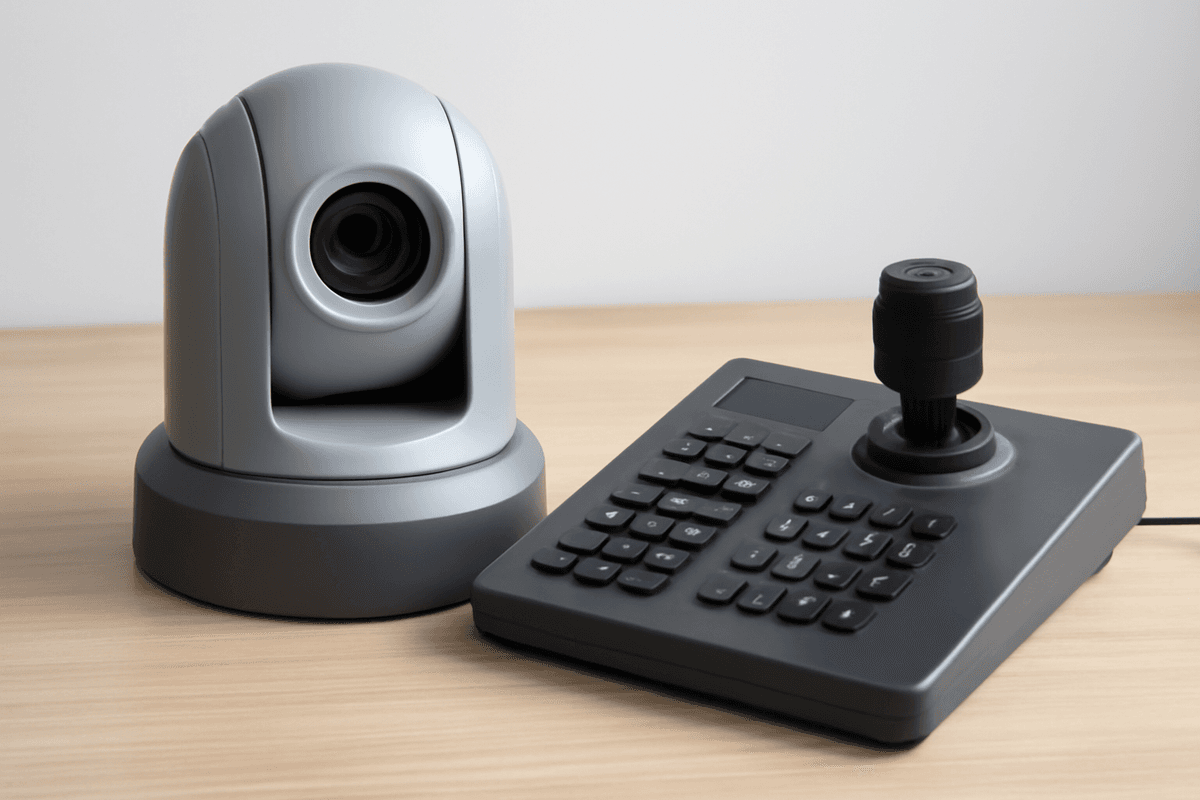
A PTZ camera and controller only work as well as the weakest link between them: buy either piece without checking the protocol, and you'll end up with a joystick that can pan but never zoom, or a camera that ignores half its presets. Get the pairing right — ONVIF or Pelco-D/P, sufficient PoE budget, and a controller matched to how you'll actually operate the system — and one dome can genuinely replace a bank of fixed cameras. Get it wrong, and you've bought two separate boxes that happen to share a shelf.
As BZBGear's installer guide notes, the hardware-joystick-versus-software debate comes down to operational context: a hardware joystick suits a staffed control room where an operator needs tactile, instant response, while a software app (PTZOptics' own controller app being a common example) suits remote or multi-site management from a PC or tablet. Neither is universally better — the right answer depends on who is operating the camera and from where.
One gap competitors rarely address is analogue-to-IP protocol compatibility: PTZOptics' app page covers IP/ONVIF control only, and most Amazon listings ignore the question entirely. If your NVR or cabling is RS-485-based, you need a camera and controller that both speak Pelco-D or Pelco-P at a matching baud rate — ONVIF commands simply won't reach a coax-connected speed dome.
What actually matters when choosing a PTZ camera and controller
Four criteria separate a system that earns its keep from one that frustrates within six months: optical zoom range, low-light sensor performance, PoE power budget, and controller interface. Get these right and everything else — mounting, presets, protocol — falls into place.
1. Optical zoom range (and why digital zoom is irrelevant)
Always buy on optical zoom; ignore digital zoom figures entirely. Digital zoom is pixel interpolation — it degrades image quality and produces footage that is rarely evidentially useful. Optical zoom physically moves glass, preserving resolution at range.
For most UK perimeter and car-park applications, 25× optical zoom is the practical sweet spot. The Hikvision DS-2DE4A225IW-DE(S6) covers a 4.8–120 mm focal range at 25×, which at 2MP Full HD (1920 × 1080) gives usable face detail at distances that a fixed wide-angle camera simply cannot reach. Step up to a 4MP sensor with the same zoom ratio and you gain the ability to crop in post without losing evidential quality.
A common installer mistake is specifying maximum zoom without checking minimum focal length — a lens that starts at 4.8 mm gives a wide enough field of view for area surveillance before zooming in, whereas a lens starting at 7 mm or longer leaves blind spots close to the camera.
2. Low-light and sensor performance
Sensor size and technology determine whether your PTZ camera and controller investment delivers usable night footage — IR range and resolution figures printed on the box are secondary. A 1/1.8-inch progressive scan CMOS sensor, as found on the Hikvision DS-2DE3A400BW-DE/W-F1 4MP ColorVu, captures colour in near-darkness by gathering significantly more light per pixel than a smaller 1/2.8-inch chip at the same resolution. In our installs across UK car parks and retail yards, this difference is visible and consistent: the larger sensor holds colour and detail at ambient light levels where a smaller chip switches to monochrome or produces noisy, unusable frames.
ColorVu technology pairs that large sensor with a wide-aperture lens and a supplemental white-light LED, producing full-colour footage without relying solely on infrared. The trade-off is that the white-light illuminator is visible when it fires — not a problem for most security applications, but worth noting for covert or aesthetically sensitive sites. For sites where IR is preferred, the [
Hikvision DS-1604ZJ-POLE-P Pole Mount Bracket for PTZ CCTV Cameras — best for pole and column installs
A simple, purpose-built adapter that lets you fit a standard Hikvision PTZ wall bracket onto a pole or column, ideal where you've no wall or eave to mount to — car parks, perimeters, street furniture, and yard poles.
- Aluminium alloy construction — built to shrug off UK weather and hold a PTZ's weight and vibration without sagging over time.
- Designed as an adapter, not a standalone bracket — it converts a wall-mount fixing to a pole/column fixing, so you'll still need the matching Hikvision PTZ wall bracket alongside it.
- Model-specific fit — DS-1604ZJ-POLE-P is engineered around Hikvision's own PTZ bracket range, so check your wall bracket model is listed as compatible before ordering; mixing third-party brackets risks an insecure fit under load.
In our installs across UK car parks and yard perimeters, a pole-mounted PTZ on a 6 m column is often the only practical option — there's simply no suitable wall within cable run. The aluminium alloy construction has held up reliably in exposed coastal and urban sites without the bracket creep you sometimes see with cheaper steel adapters after a winter.
Hikvision DS-2AE5225TI-A-E 2MP 25x PTZ Turbo HD Camera — best for long-throw analogue/HD-TVI upgrades on a budget
A 2MP HD-TVI speed dome with a genuine 25× optical zoom, this is the pick for installers replacing an ageing analogue PTZ on coax without pulling in new cabling or a PoE switch.
- 25× optical zoom, 4.8–120 mm motorised lens — enough reach to identify a face or plate at distance on a large yard or car park, not just wide-area orientation.
- HD-TVI and CVBS BNC output — drops straight onto existing coax runs and a Turbo HD/analogue DVR, which is the main reason to choose this over an IP PTZ.
- Up to 150 m Smart IR — genuinely useful night-time reach for perimeter or car park duty, though actual usable range depends on scene reflectivity and ambient light (per Hikvision's own datasheet figures).
- 120 dB True WDR with 3D DNR — handles harsh backlighting (gates, entrances facing low sun) and cleans up noise in low light, both of which matter more than raw resolution for usable evidential footage.
- 2MP (1080p) sensor — plenty for live monitoring and general identification, but if you need to crop into digitally zoomed footage after the fact for court-standard detail, a higher-resolution PTZ will hold up better.
Trade-off: this is a coax-only camera, so you get no PoE, no ONVIF, and no native IP control. PTZ commands travel over the coax via Hikvision's Turbo HD protocol or RS-485, meaning your DVR or hardware joystick keyboard must support HD-TVI PTZ control — a pure IP NVR will not drive it. If your site is already cabled in Cat5e/6 and running an IP NVR, step up to the Hikvision DS-2DE4A225IW-DE(S6) 2MP DarkFighter 25× PTZ PoE Dome Camera instead. In our experience fitting these across UK car parks and industrial yards, the coax retrofit angle is the genuine selling point — sites that would otherwise face a full recable can keep their existing DVR and simply swap the head unit.
Hikvision DS-2DE3A400BW-DE/W-F1 4MP ColorVu PTZ PoE Network Camera — best for colour night coverage on a budget
A PoE-powered 4MP PTZ dome that keeps full colour after dark, making it the pick for car parks, yards and building perimeters where installers need motorised coverage without a separate NVR licence headache.
- 4MP (2560×1440) on a 1/1.8" sensor gives noticeably sharper detail than typical 2MP PTZ domes for reading plates or faces at range.
- 350° pan / 0–90° tilt motorised movement covers a full site sweep from one pole or wall mount, cutting the number of cameras needed.
- Fixed 4mm F1.0 ColorVu lens (88.7° HFOV) is built for low-light colour retention rather than long-range zoom.
- Single-cable PoE install simplifies cabling runs versus 12V/24V speed domes.
The trade-off: no optical zoom means this is a wide-coverage camera, not a long-range identification tool. If you need to pull in a face or plate from 40 m+, step up to the Hikvision DS-2DE4A225IW-DE(S6) 2MP DarkFighter 25× PTZ with its 4.8–120 mm motorised lens. The ColorVu's strength is blanket colour coverage across a wide arc — in our installs on UK car parks and yard entrances, it reliably holds usable colour at light levels where a standard IR dome switches to monochrome. Control is via ONVIF-compatible NVR or IP software; there is no RS-485/Pelco-D port on this model, so hardware joystick keyboards that rely on coax or serial control are not compatible — pair it with an ONVIF-capable VMS or the Hik-Connect app instead.
Hikvision DS-2DE4A225IW-DE(S6) 2MP DarkFighter 25× PTZ PoE Dome Camera — best for long-throw perimeter coverage
A 2MP PoE PTZ dome built around 25× optical zoom and DarkFighter low-light processing, best suited to installers covering car parks, yards or perimeters where reach matters more than pixel count.
- 25× optical zoom (4.8–120mm) gives genuine long-range identification, letting one camera replace several fixed lenses on large sites.
- 1080p CMOS sensor with DarkFighter processing favours usable low-light contrast over headline resolution — a sensible trade for night-time perimeter work rather than daytime fine detail.
- Smart Supplement Light IR up to 50 m (actual range depends on scene reflectivity and mounting height) extends usable night range without relying purely on ambient light.
- PoE powered, simplifying cable runs to a single Cat5e/6 run per camera and cutting install time versus separate 24V AC supplies.
- Motorised PTZ mechanism supports auto-tracking and preset tours, so it can be driven from a joystick controller or via VMS software presets — worth planning your control setup (keyboard vs. software) before install, as both routes need continuous IP connectivity to the camera.
Trade-off: if you need daytime facial or number-plate detail across a wide area, step up to the 4MP ColorVu PTZ, which trades the DarkFighter low-light processing for a larger 1/1.8" sensor and full-colour night imaging. For pure perimeter reach in mixed lighting, the DarkFighter 25× remains the stronger choice — in our experience fitting similar units across UK car parks, the zoom range and IR performance hold up well on poles at 5–6 m, covering yard entrances out to 40–50 m with usable detail.
Which one should you buy?
Buy the 2MP DarkFighter 25× PoE dome if you want one all-rounder; step down to the Turbo HD analogue-style model on a tight budget; step up to the 4MP ColorVu model if colour-at-night on a car park or yard entrance is the job. Match the controller to how many cameras you're actually running rather than buying a full keyboard "just in case."
Budget pick
For a single-camera retrofit onto an existing coax or Turbo HD run, the Hikvision DS-2AE5225TI-A-E gives 25× optical zoom and 2MP 1080p resolution with up to 150 m Smart IR range (actual range depends on scene reflectivity and target size). Control it via your existing Turbo HD DVR or a basic RS-485 joystick keyboard using Pelco-D/P protocol — no network switch or PoE budget to worry about. In our installs across UK car parks and yard entrances, this model is the most common retrofit choice where coax is already in the ground.
Frequently asked questions
What is a PTZ camera?
PTZ stands for pan-tilt-zoom — a single motorised camera that can rotate horizontally, tilt vertically, and zoom in on detail, giving operators live coverage that would otherwise need several fixed cameras. Models like the [Hikvision DS-2DE3A400BW-DE/W-F1 4MP ColorVu PTZ](https://cctvline.co.uk/products/d5du6qe6xerl01go5e1ekwgn) illustrate this in hardware terms, offering 350° pan and 0–90° tilt from one unit.
What is the disadvantage of a PTZ camera?
The main disadvantage is that a PTZ camera can only look in one direction at a time — if it is patrolling a preset tour or an operator is zoomed in on one area, the rest of the scene is unmonitored. Fixed cameras provide guaranteed, uninterrupted coverage of their field of view; a PTZ does not. Motor mechanisms also add a point of failure that a fixed dome simply does not have.
How do you control a PTZ camera?
PTZ cameras are controlled either over IP, using ONVIF or CGI commands sent across the network, or over analogue RS-485 wiring using the Pelco-D or Pelco-P protocol. This choice — IP versus analogue/RS-485 — is the single biggest compatibility decision when pairing a camera with a controller. In our installs across UK car parks and retail sites, we find most new deployments default to ONVIF over IP, reserving RS-485 only where existing coax infrastructure makes rewiring impractical.
- ptz
- camera
- controller

Related reading
- Hikvision ANPR Camera: Setup & UK Legal Guidehikvision anpr camera
- Best Hikvision PTZ Cameras: 2026 UK Reviewhikvision ptz camera
- Hikvision PTZ Cameras: Every Current UK Model Compared (2026)hik ptz camera
- Best 4K PoE CCTV Camera UK 2026best 4k poe cctv camera
- What Does an ANPR Camera Look Like? Visual ID & Technical Anatomy 2026what does an anpr camera look like
- Best CCTV Home Systems in the UK 2026: Buyer's Guide by Property Typecctv home system