Recorders & Storage
CCTV Audio Recording Laws UK 2026: Legal or Illegal?
Yes, you can legally record audio on UK CCTV — but the bar is higher than for video alone, and most systems that ship with a built-in microphone are switched…
On this page
- Is audio recording on CCTV legal in the UK?
- Why audio is treated differently
- What this means in practice
- When does CCTV audio tip into unlawful covert surveillance?
- How do you make a CCTV audio setup compliant, step by step?
- Hardware to match the policy
- Mic-enabled cameras vs standalone voice recorder modules: which should you specify?
- Quick decision guide
- Who's responsible for signage, retention and subject access requests once audio is live?
Yes, you can legally record audio on UK CCTV — but the bar is higher than for video alone, and most systems that ship with a built-in microphone are switched to audio-off by default for good reason. Under UK GDPR and the ICO's guidance, continuous audio capture counts as more intrusive than video because it inevitably picks up private conversations that were never meant to be recorded, so it demands its own justification, signage, and necessity test. Get it wrong and you've not just broken data protection law — you may have strayed into covert surveillance territory, the same legal grey area as secret voice recorders. This article sets out exactly when audio is defensible, when it isn't, and how to configure it properly if you decide it is.
Is audio recording on CCTV legal in the UK?
Yes, but only where it's proportionate, disclosed, and no more intrusive than the purpose actually requires — audio sets a higher bar than video alone under the ICO's CCTV guidance. Recording pictures of a car park or shop floor is one thing; capturing every word spoken within microphone range is a materially different privacy intrusion, and the law treats it that way.
Audio is not "free" just because the camera has a microphone — it needs its own justification, not a video justification stretched to cover it.
Why audio is treated differently
UK GDPR and the Data Protection Act 2018 both treat continuous audio capture as more intrusive than video, because a microphone can pick up private conversations that were never intended for recording — a phone call, a personal argument, a confidential customer discussion. Video shows what happened in a space; audio can capture exactly what was said, which is a much wider category of personal data.
That distinction matters for the legitimate interest and necessity test installers and operators have to satisfy. Justifying video coverage of a car park to deter vehicle crime is usually straightforward. Justifying continuous audio recording of every conversation held in that same car park is a different, harder test — most operators can't show it's necessary or proportionate for that purpose.
What this means in practice
- Assess audio separately from video in any data protection impact assessment or risk assessment, don't bundle it in as a bonus feature.
- Disclose audio recording specifically on signage, not just "CCTV in operation" wording that implies pictures only.
- Only enable audio where there's a clear, narrow purpose it serves that video can't — general deterrence usually isn't enough.
- Review footage retention and access controls with the same rigour as video, since audio can be more sensitive if it leaks.
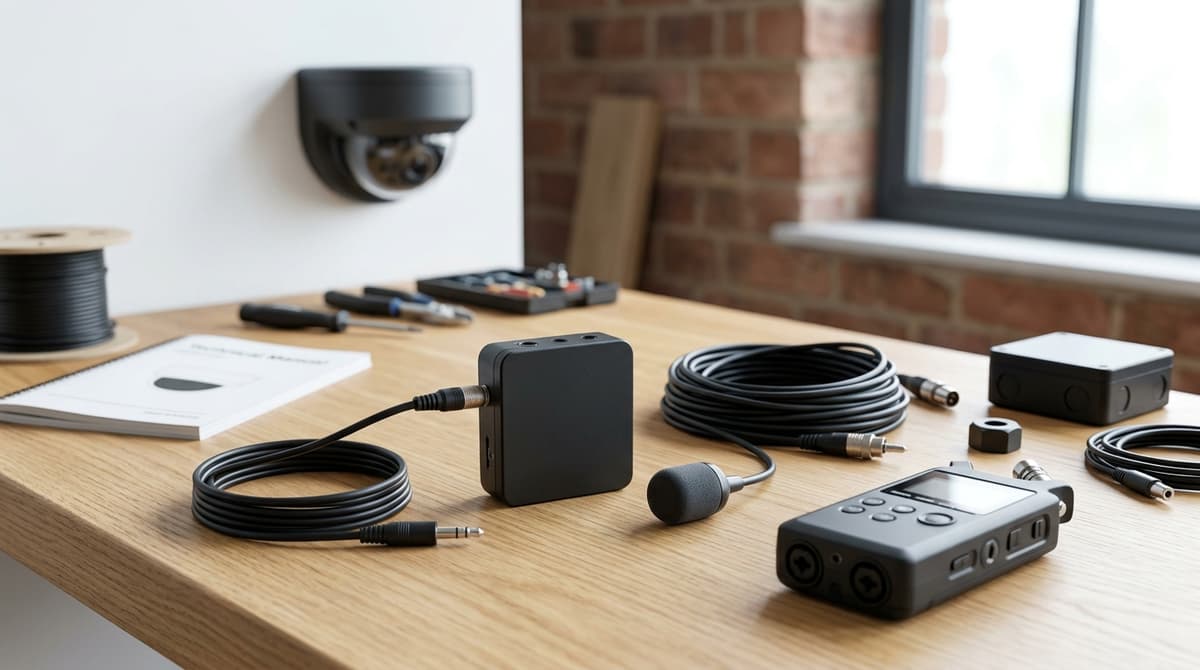
Many Hikvision and Dahua recorders and cameras sold through CCTVLine's recorders range support audio input, and add-on modules such as CCTVLine's high-gain CCTV microphone module can be wired into an existing DVR or NVR — but stocking the hardware doesn't answer the legal question. That decision sits with whoever operates the system and has to justify it if challenged.
When does CCTV audio tip into unlawful covert surveillance?
CCTV audio becomes unlawful covert surveillance the moment it captures conversation where people have a reasonable expectation of privacy and haven't been told that sound is being recorded. Video alone, clearly signed, is one thing; capturing what people say is a much higher bar in UK practice.
Audio recorded in a staff break room, at a shop counter during a customer conversation, or drifting over a fence into a neighbour's garden without clear signage moves you from ordinary CCTV monitoring into covert audio surveillance. Public bodies answer to RIPA-style tests of necessity and proportionality for this kind of intrusion; the ICO applies equivalent proportionality reasoning to private organisations through UK GDPR, since continuous audio capture is treated as more intrusive than video and harder to justify.
Employers face a double exposure. Recording staff conversations without telling them risks a UK GDPR breach for processing personal data unfairly, and separately risks an Article 8 Human Rights Act privacy challenge if the recording is ever tested at a tribunal or in court.
Fitting a CCTV audio module is a technical decision; whether to switch audio on is a legal one, and they shouldn't be made by the same person without a policy behind it.
Key takeaway: if you wouldn't be comfortable telling the person "yes, we're recording your voice," don't record it — mute the channel or don't fit the microphone at all.
How do you make a CCTV audio setup compliant, step by step?
Compliance comes from process, not equipment: run a short necessity check, disclose properly with updated signage, record a DPIA, then set retention to match — most failures we see on site are a missed signage or retention step, not a faulty microphone module.
Step 1 — Necessity test. Ask whether the same purpose — deterrence, or evidence of an incident — is achievable with video alone. If video alone would do the job, adding audio increases privacy risk without adding lawful benefit, since continuous audio capture of conversations is treated as more intrusive than image capture alone.
Step 2 — Signage. Update every sign to state clearly that audio is being captured, not just images, following the ICO's video surveillance guidance. Signs need to be sited where people can actually read them before they enter the recorded area — a sign at head height by a shop's till does nothing for someone recorded in the car park.
Step 3 — DPIA. For any workplace, retail, or public-facing audio deployment, keep a written Data Protection Impact Assessment showing you weighed the risk against the purpose. This is typically the first document the ICO asks for when a complaint about audio recording lands.
Step 4 — Retention and access control. Set retention on the recorder to the shortest period that still serves the stated purpose, and restrict playback of audio-tagged footage to named staff only, logging who accessed it and why.
Hardware to match the policy
Once the paperwork is settled, configure recorders so audio is switched off by default on channels that don't need it, and only enabled where the DPIA supports it. A dedicated add-on such as our CCTV High-Gain Microphone Module (RCA & 2.1mm jack) lets installers wire audio into a single junction box or camera housing rather than leaving every channel live by default — useful where only one entrance genuinely needs audio evidence. Trade buyers speccing multi-channel jobs can open a trade account at cctvline.co.uk/account to check recorder channel counts and audio-input support before ordering.
Mic-enabled cameras vs standalone voice recorder modules: which should you specify?
For most installers, a mic-enabled camera is the easier system to keep compliant, because audio and video share one recording, one retention clock and one access log — a separate voice recorder running in parallel just gives you a second dataset to govern under UK GDPR and the ICO's CCTV guidance.
Built-in microphones are now standard on many Hikvision and Dahua camera lines, which is exactly why they get misused. Having a mic on board doesn't mean audio should be live — it's typically a menu toggle in the camera's audio settings, and it should stay off unless the client has actually done a documented necessity check justifying audio capture alongside video.
Where a standalone module earns its place
A dedicated audio unit makes sense when only one zone needs sound — a till point, a goods-in intercom, a reception desk — rather than switching audio on across an entire site. The CCTV High-Gain Audio Module (RCA & 2.1mm Jack) we stock at CCTVLine is built for exactly this: it's compact enough to fit inside a junction box, camera housing or equipment cabinet, and it can share the same power run as the camera it's paired with rather than needing its own separate supply.
That single-zone approach also keeps your compliance paperwork smaller. One microphone, one purpose, one retention period to justify — instead of trying to defend audio capture across a whole building on the same policy document.
Quick decision guide
| Scenario | Recommended approach |
|---|---|
| Whole-site audio genuinely justified | Mic-enabled camera, audio toggle on, one unified log |
| Audio needed at one till/intercom only | Standalone module paired to that camera's power run |
| No documented necessity check done yet | Leave mic off / don't add a module until it's done |
The pattern to avoid is running a mic-enabled camera and a separate recorder covering the same zone — that duplicates the audio trail without adding coverage, and it's the first thing an ICO complaint investigation will flag as unjustified. Browse camera and accessory stock, or open a trade open a trade account, at cctvline.co.uk.
Who's responsible for signage, retention and subject access requests once audio is live?
The data controller — usually the business or landlord operating the system — carries all statutory duty here, not the installer who supplied or fitted the equipment. Once a CCTV audio module is switched on, that footage and sound become personal data under UK GDPR, and the ICO's guidance on video surveillance treats audio capture as significantly more privacy-intrusive than image alone, because it can pick up conversations never intended for recording (ICO).
Signage must be clear and visible before someone enters the recording zone, and where audio is enabled specifically, the ICO advises signage should say so — a standard "CCTV in use" notice does not cover sound capture. Retention needs a documented period with a defined deletion process; the controller sets this, not the installer, and it should be no longer than the stated purpose requires.
Subject access requests land on the controller too — anyone can ask for a copy of footage or audio containing themselves, and the controller must respond, redacting third parties where needed.
As a trade supplier, CCTVLine sells the hardware — including microphone modules such as the CCTV High-Gain Audio Module – RCA & 2.1mm Jack — and does not carry out installations or advise on individual sites' compliance; installers and end users should build signage and retention obligations into every audio-enabled design from the outset. Open a trade account at cctvline.co.uk/account to check current stock.
This article was researched and written by IT Master.